

- Article
The Aesthetics of Terror: An Essential History of Dracula’s Fangs - Part Two
As we celebrate the upcoming 4K restoration and release of Dracula (1958) we’re re-examining the film itself and its enduring legacy. This two-part feature traces the genesis and evolution of Dracula’s fangs, and how they came to be so central to our vision of the character.
Part One covered the first few thousand years of the topic, stretching from ancient Egypt to silent movies and early talkies. Now we delve into the 1950s, a time of real change for vampiric mythology as Christopher Lee made his mark in more ways than one…
The Turkish black-and-white movie, Drakula İstanbul'da (1953) directed by Mehmet Muhtar, comes across as a curious movie, thrilling and jarring in almost equal measures. It’s surprisingly true to Stoker’s source material and although Atif Kaptan spends much of the film looking like a butler from innumerable Laurel and Hardy two-reelers, his portrayal of the Count is significant for one (or technically two) prominent reasons.
He has fangs.
The first fangs.
Fangs which we see in the opening moments of the movie. They’re not sharp or sleek and they jut out, almost apologetically, looking more like sweet little tusks than dentures of doom. But unless a lost film is unearthed which proves otherwise, this is the first screen iteration of a Dracula who has something resembling his trademark teeth.

In terms of its physical depiction of the Count, Drakula İstanbul'da (Dracula in Istanbul) pays lip service to Stoker’s novel, but it’s the first known film to give him teeth which resemble fangs.
Coming four years later, a little confusingly, Blood of Dracula (1957) doesn’t actually feature the eponymous villain, but it follows the story of Nancy, an American student who - through no fault of her own - becomes caught up in a scheme to evolve vampires in order to help humanity and prevent nuclear wars. No, really.
Even more surprising, the film isn’t as bad as it sounds and features some atmospheric moments and effective scares. Sandra Harrison is great fun as Nancy, eliciting sympathy when she’s portraying a put-upon new girl who’s targeted by school bullies, and absolutely going for it when her character gets to exact revenge. Notably, not only does Nancy possess fangs when she switches to vampire mode, we actually see them elongating in one wonderfully OTT transformation scene that prefaces one of her feeding frenzies.

Writing for the Horror Society, Mitchell Wells said of Blood of Dracula, ‘At the very least this is a nice example of trashy drive in cinema fun.’
Perhaps even more importantly, the same year gave us the Mexican horror flick, El vampiro (1957), directed by Fernando Méndez. The vampiro in question is Count Karol de Lavud played by German Robles, who ensures the antagonist is a smooth, engaging killer. He looks like he’s dressing for a Bela Lugosi tribute act, but his performance is cultured, at times subtle, and in terms of both charisma and eeriness he proves an excellent ambassador for the undead.
His fangs make an appearance whenever he’s about to sink them into a victim’s throat, and more significantly, they look similar to those Christopher Lee would shortly showcase. Karol de Lavud’s may be a little longer than those flashed by Dracula the following year, but they’re the first cusped canines which at first glance could be mistaken for those used by Hammer throughout the late 50s, 60s and 70s.

German Robles in El vampiro (above) proved popular enough to trigger a sequel, El ataúd del vampiro (The Vampire's Coffin) which hit cinemas in 1958.
Curiously, the team behind El vampiro chose to underplay this element and many posters for the movie carried images of Robles sans prosthetic choppers. They’re used sparingly, glimpsed just a handful of times throughout the film, and we really only get a good (albeit brief) look at them once. Conversely, Hammer went all in.
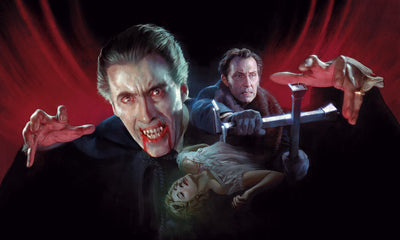
Marketing materials for Dracula showed Lee as the ‘Lord of Corruption’, mouth menacingly open to reveal his fabulous fangs. Most posters, advertisements and many lobby cards exploited the visual which instantly redefined the Count’s appearance in popular culture.
Within the movie itself we don’t witness the fangs when he initially makes his entrance, but their first appearance hits like a sledgehammer. It comes after a period of relative calm, when he launches a gloriously furious attack on Harker and a fellow blood sucker, played by Valerie Gaunt, in his castle’s library. Accompanied by James Bernard’s music at its most feverish, we get a close-up of Dracula that reveals his face is already, to use John Stagg’s phrasing from a century and a half earlier, ‘besmear'd / With clott'd carnage’. And, of course, figuratively and literally, he bares his teeth, so in a single dramatic shot we see the figure anew.
Dracula reborn. Van Helsing is no longer the only one with pointed weaponry with which to attack his prey; Hammer’s Prince of Darkness is literally armed to the back teeth.

Christopher Lee’s iconic look debuted in Dracula (above) and was still thrilling audiences when he bowed out as Hammer’s infamous vampire in The Satanic Rites of Dracula (1973).
Crucially, this is the first time in the film where Dracula drops the sham of being an innocent nobleman who’s engaging Harker for a regular commercial enterprise. In this pivotal scene we perceive him as he truly is, which in itself necessitates the fangs. With them he becomes the stuff of nightmares. A vampire, first and foremost. Deadly, bloody and bloodthirsty. His canines are literally a part of him, but they’re also an authentic insight into his raison d'être and unholy modus operandi; they’re as telling and as vital as Medusa’s serpentine hair, or the shark’s spike-like teeth on the cover of Jaws.
The look was devised by Phil Leakey, working closely with Lee and director Terence Fisher. One version of the dental prosthetic incorporated a tiny reservoir of stage blood. By pressing his tongue against his palate, Lee could operate a miniscule pump which forced the fluid along the false teeth. Or at least, that was the plan. Remembering the reality, Leakey later admitted, ‘He tried this once and jolly nearly choked!’
In truth, the success of the pontics was down to something far more basic. Put simply, they look great. The dentistry of say, Max Schrek as Orlok, Sandra Harrison as Nancy and even Atif Kaptan as Drakula, makes their characters seem repulsive. Although Lee looks terrifying with fangs exposed, there’s also a snarling elegance to the picture he presents. It’s restrained enough to somehow appear plausible, hinting at virility and perhaps even nobility.

As seen here in a poster for Taste the Blood of Dracula (1970), the fangs became a significant element of Hammer’s marketing campaigns for their ongoing series.
Years later when Hartswood Films were developing their 2020 version of Dracula for the BBC and Netflix, the firm’s creatives initially toyed with the idea of their main man having ‘attack teeth’ that resembled lamprey. Co-writer Mark Gatiss explained why the concept was nixed, musing, ‘You have to think how you want your lead to look really great and dashing…’ He commented on the ‘sex appeal’ associated with Dracula and added, ‘…one night with Dracula is worth dying for. Whereas, one night with a lamprey, you might go, I'm all right, thanks!'
Exec Producer Sue Vertue summed it up succinctly. ‘We went through quite a lot of different ideas about what the teeth would be like. And in the end, you come back to more of a traditional (version).’ In other words, the Christopher Lee look allows the Count to remain handsome whilst appearing completely vampiric.

The fangs weren’t only seen in Hammer’s Dracula movies, and Ingrid Pitt makes them her own in this dramatic moment from The Vampire Lovers (1970).
Other vampires in Dracula displayed similar dental work meaning ‘the look’ wasn’t solely confined to the central character. This proved significant as the type of fangs that debuted in the work were subsequently used for all Hammer films featuring any vampires. And after it premiered, pretty much every production depicting Dracula or his brethren, from the serious and scary like Dance of the Damned (1989) and Queen of the Damned (2002), to the broadly humorous, such as comedies including The Lost Boys (1987) and even Buffy the Vampire Slayer (1992), uniformly followed the lead set in 1958 by Leakey, Lee and Fisher.
There’ve been occasional tweaks and slight modifications down the years. Examples include the mesmerizing A Girl Walks Home Alone at Night (2014), marketed as ‘The first Iranian vampire Western’. It stars Sheila Vand as an undead avenger with slightly longer and more curved fangs. And in Blade: Trinity (2004) Parker Posey as Danica Talos wears upper and lower sets of sharpened canines, which looks interesting but feels like a bridge too far.

Recognise this depiction of Dracula? It’s a detail of the artwork Van Helsing keeps on his living room wall in The Satanic Rites of Dracula.
Invariably, when these variations are deployed, critics comment on the teeth and how they differ from the ‘accepted’ look of vampiric prosthetics, a further indication that Lee’s remain the OGs and more, that audiences still primarily associate vampires with Hammer’s version of the undead, complete with two small but fearsome fangs.
It’s been over 65 years since that striking aesthetic made its debut, but it endures, as universally ingrained and as popular as ever. Vampires still live forever, and similarly, it seems, the idea of their fangs will never get long in the tooth.