

- Article
The Aesthetics of Terror: An Essential History of Dracula’s Fangs - Part One
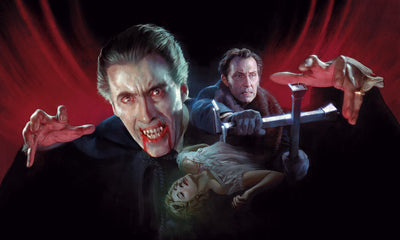
As we look forward to the 4K restoration and release of Dracula (1958) later this year, we’ll be rediscovering the movie, its impact and legacy. It was the film which gave us the definitive version of Bram Stoker’s vampire and redefined his look, establishing forever how he’s physically represented onscreen and in the public consciousness.
His fangs remain central to this manifestation, and Hammer’s adaptation was the first production that presented a Dracula with canines as we know them today. In this two-parter we’ll be tracing their origins and evolution, from ancient Egypt, early vampire lore and seminal horror films to the moment cinema audiences screamed at the sight of a new aesthetic of terror…
You don’t even need to see them properly. Simply glimpse a pair of fangs in any context outside of the animal world and the association is clear. Add a cape and the significance becomes even more blatant. The fangs could be in the form of a simple graphic – just the teeth by themselves, possibly dripping blood, and their meaning remains unmistakable. These sharp, curved canines symbolise one thing. One figure. The Prince of Darkness himself: Count Dracula.
It's a curiously strong and universal connection. Any child turning up to a Hallowe’en party in formal attire and a cape might be seen as cosplaying a random Victorian ‘toff’. But if their smile reveals short, sharp fangs, pretty much anybody, regardless of age or interest in the horror genre, will instantly know that Dracula has entered the building.
As emblems of a fictional character they’re almost unique. Only Sherlock Holmes and James Bond have similar tells that resonate quite so broadly. A deerstalker and a magnifying glass are synonymous with the Great Detective whilst a tux and a pistol, when combined, invoke the British not-so secret agent, 007.

A cover from the long-running series of penny dreadfuls, Varney the Vampire… Absolutely nothing to do with Hammer’s On the Buses (1971).
Yet literature’s earliest stories featuring vampires made no explicit reference to the undead having unusual teeth, and the first prose to reference this aspect is held to be Varney the Vampire; or, the Feast of Blood, a serialised epic published in 1845 to1847, and usually attributed to James Malcolm Rymer and Thomas Peckett Prest. In that influential work, Varney is described in a wonderfully dramatic passage, cannily delivered in the present tense for maximum immediacy:
‘The figure turns half round, and the light falls upon the face. It is perfectly white - perfectly bloodless. The eyes look like polished tin; the lips are drawn back, and the principal feature next to those dreadful eyes is the teeth - the fearful looking teeth -projecting like those of some wild animal, hideously, glaringly white, and fang-like.’
In that moment, in those few florid and gripping words, vampires sprouted fangs. The image is such a striking one and holds such macabre appeal that there could be no going back, and when Dracula swooped into being over a half a century later, Bram Stoker inevitably gave his creation this trademark abnormality.

The author of Dracula, Bram Stoker (1847 –1912), photographed in 1906.
But the connection between teeth and terror, power and even prestige began long before Varney made fangs de rigueur for any self-respecting vampire. Dental modification was common in ancient Mayan culture with gems such as jadeite, turquoise and quartz inserted into front teeth. Similarly, as far back as 2700 BCE, Egyptians used precious metals, most commonly gold, as a form of dental enhancement. Although historians are divided as to the purpose of these practices, many believe they were social signifiers, with the modified teeth intended to produce not fear exactly, but a degree of low key awe.
Viking warriors were more bellicose with their intentions. These marauders from the late-8th to the mid-11th centuries routinely had horizontal lines carved across their central incisors and dyed the shallow grooves red using natural ochre. It’s safe to assume they weren’t aiming for a friendlier smile, and the implied threat was terrifying: we will taste your blood.
Mythology also teems with creatures whose ferocity is signified by their teeth, such as the Chupacabra, wendigos and lesser-known beasts like the manticore, a nightmarish creature found in old Persian tales. The Encyclopaedia of Things That Never Were describes the monster as having ‘…the body of a lion and a head with some resemblance to that of a human male, except that the awful gaping mouth is filled with three [count them – three!] rows of razor-sharp teeth.’ In each instance, as with Hammer’s Dracula, these entities’ gruesome grills telegraph their owner’s power and predatory intent.
The same book also reveals the teeth of dragons were once believed to be so potent that planting them would yield an army of ferocious soldiers. This grow-your-own army technique was said to have been first used by Cadmus, King of Thebes. Unfortunately, the newly created militia (known as Sparti) were uncontrollably brutal. ‘When Cadmus sowed dragons’ teeth,’ the Encyclopaedia informs us, ‘the resulting Sparti fought so savagely [amongst themselves] that only five survived.’

Mythological creatures with fanged teeth, such as the werewolf (above) have existed for centuries.
Modern-day myths are equally fond of employing teeth as symbols of strength and dread. When novelist Peter Benchley wrote his break-out hit he originally considered calling the book The Stillness in the Water or Leviathan Rising. But entitling it Jaws proved a masterstroke.
The US first edition hardback features the familiar image of a shark (mouth almost closed, so it’s little more than a dark crescent) surging upwards towards a lone figure who’s swimming across a pitch-black ocean. It’s an effective, moody image. But when Jaws was published in paperback the visual was tweaked. The shark now rises towards its prey with mouth agape to reveal an improbable set of huge, white, knife-like gnashers. Anatomically it was wildly inaccurate. Visually it bit deep and hard. The artwork was used for the basis of the movie’s poster and swiftly became an icon of twentieth century cinema. The marketing people knew what storytellers had grasped for centuries: teeth matter.
In retrospect, Jaws wouldn’t have been a bad title for Stoker’s most celebrated novel. In fact, John Stagg’s poem, The Vampyre from 1810, contains the following verse, describing the appearance of the eponymous fiend:
His jaws cadaverous were besmear'd
With clott'd carnage o'er and o'er,
And all his horrid whole appear'd
Distent, and fill'd with human gore!
Yikes! But anyone reading Dracula and hoping to find a description of its central character that defines the suaveness which Christopher Lee embodied, will be disappointed. The Count, as described in the original novel via the lawyer, Jonathan Harker, is physically at least, a very different beast:
‘His face was a strong - a very strong - aquiline, with high bridge of the thin nose and peculiarly arched nostrils, with lofty domed forehead, and hair growing scantily round the temples but profusely elsewhere. His eyebrows were very massive, almost meeting over the nose, and with bushy hair that seemed to curl in its own profusion. The mouth, so far as I could see it under the heavy moustache, was fixed and rather cruel-looking, with peculiarly sharp white teeth.’
The description continues, ‘These protruded over the lips, whose remarkable ruddiness showed astonishing vitality in a man of his years.’

In terms of physical appearance, Christopher Lee’s Dracula differed greatly from the figure as originally described by Bram Stoker.
Although this is the first mention of Dracula having ‘sharp’ teeth, which ‘protruded over his lips’, they’re not explicitly termed ‘fangs’ and we’re given no further information about the Count’s pearly whites. In fact, when reflecting on his host’s appearance, Harker tells us, ‘The general effect was one of extraordinary pallor’ which implies his extreme paleness was his most striking feature. This in turn suggests that Dracula’s teeth were unusual, but not to the extent that he possessed obvious fangs. Stoker’s text also indicates all of Dracula’s teeth were sharp, another detail that mitigates against him having a pair of extended canines. If anything, the description in the novel brings to mind the mouth of Lon Chaney’s character in the 1927 silent, London After Midnight.
Dracula was published in May, 1897 and Stoker secured the stage rights to his novel that same month by holding something approaching a table read of the story, performed at his place of work which happened to be London’s Lyceum Theatre. This version, intended purely as a means to secure copyright, was a one-off. The first ‘true’, official stage adaptation premiered in May, 1924 at the Grand Theatre in Derby and proved a success, touring the provinces before finding a home just off The Strand in the quaintly named, Little Theatre in the Adelphi. There’s no indication that any of the actors playing Dracula in this version wore fangs, and theatre scholars tend to consider it improbable for reasons of practicality.
The first film featuring Stoker’s vampire is thought to be the Hungarian silent, Drakula halála (1921), also known as The Death of Drakula and Drakula’s Death. It’s impossible to ascertain if Paul Askonas (who played Drakula in the film’s dream sequences) wore fangs for his performance. Marketing material suggests this was the case, but the surviving stills of the work indicate otherwise.

Tennyson's poem of 1850, In Memoriam A.H.H., spoke of, ‘Nature, red in tooth and claw’, a reference to the natural world’s savage side. Count Orlok, with his strange teeth and bizarre talons seems to wholly embody this concept.
We can be certain, however, that Max Schreck as Count Orlok in Nosferatu: A Symphony of Horror (1922) was totally onboard the big, sharp teeth train. Although he’s not technically playing the Count, he’s Dracula in everything but name, to the extent that Florence Stoker, widow of Bram, was able to successfully sue the work’s producers for copyright infringement. Orlok’s upper central incisors are long and pointed, lending his features a rat-like, almost feral appearance. It’s disconcerting, bizarre and borders on animalistic. But then again, it’s certainly a look.

Original artwork for Nosferatu, by the film’s production designer, Albin Grau, who’s believed to have masterminded the movie’s visual ethos.
The talkie era brought new interpretations of Dracula. In Todd Browing’s 1931 adaption, although we didn’t see Bela Lugosi wearing fangs, they were implied for his character. His victims all had puncture wounds on their necks which seems to demand the presence of sharper than average teeth. This isn’t a mere incidental point. Indeed, the medical theatre scene that arrives about half an hour into the movie culminates in the doctor’s revelation, as he examines Lucy Weston, ‘On the throat of each victim – the same two marks…’

Marketing material for Todd Browing’s 1931 classic, Dracula. The Spanish-language version, shot alongside it, was largely forgotten for decades but now critics are divided as to which work should be considered the superior adaptation.
The Spanish-language version, shot using most of the same sets and during the same period as Browning’s, goes further. Director George Melford gives us a close-up of the young woman’s injury and we see two puncture wounds in a slightly discoloured area of skin that vaguely resembles a kiss mark. It’s a neat touch. And within the context of the narrative, it’s difficult to imagine the circular entry points were caused by anything other than fangs.
Lon Chaney Jr and later John Carradine took over Dracula duties for a succession of Universal productions throughout the 40s, before Lugosi donned the cape for a second time onscreen in Abbott and Costello Meet Frankenstein (1948). For each of these outings, there wasn’t a fang in sight, but they were soon to begin proliferating throughout the 1950s…
In the second and final part of this feature we’ll be looking at fangs in the 50s and beyond as a Turkish horror, Mexican cinema and an astonishing American B-movie come under the spotlight. And, of course, we’ll be revisiting Hammer’s Dracula and examining how the team behind that classic established new vampiric lore.