

- Article
Coming Soon: Mantrap
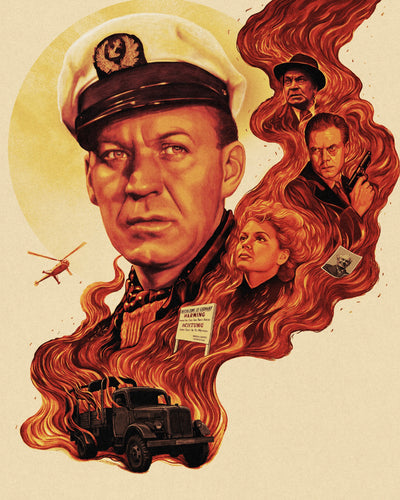
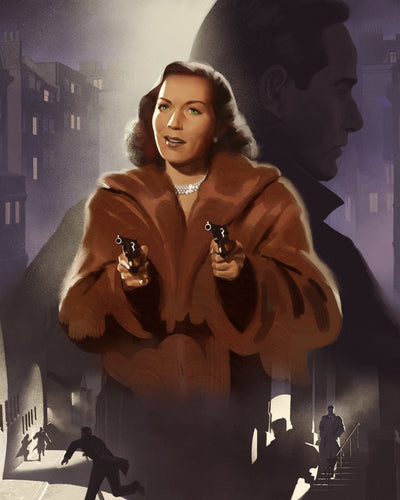
We’re delighted to confirm that the next title to be restored and released as part of Hammer’s Limited Collector’s Edition Range will be Mantrap (1953), an atmospheric thriller known as Man in Hiding in the US. That means we’re heading back to the 1950s to find a charismatic detective who operates in a London that still shows the battering it took in the blitz. Although the bombs have stopped falling, the city is more dangerous than ever for private eye Hugo Bishop as he tries to stay one step ahead of a mysterious killer…
It also means we paid our first visit of the year to Hammer Towers so we could get the skinny from our inside man, Steve Rogers…
Hammer News: In one sense this is the perfect addition to the range as it completes Hammer’s Paul Henreid double-bill, coming, as it does, so soon after the release of Stolen Face (1952). Was that the plan all along?
Steve Rogers: No, but it’s a happy accident as it’s a timely reminder just how good Henreid was as an actor. In Stolen Face he deftly handled the melodrama by playing what is arguably the film’s villain as a hero. In Mantrap Henreid turns up the charm as a man of privilege trying to prove another man’s innocence because it’s the right thing to do.
HN: Before we dive any deeper, and without giving away any spoilers that touch on the killer’s identity, could you give us an idea of the plotline?
SR: A convicted killer escapes from prison in an attempt to prove his innocence. His ex-wife, trying to rebuild her life, lives in a state of terror knowing he’s on the loose.

Paul Henreid as Hugo Bishop in his second feature for Hammer. The Los Angeles Times called him, ‘…the epitome of the continental lover - suave, articulate and stunningly handsome.’
HN: I enjoyed the central mystery because unlike many whodunnits, the culprit (or culprits) wasn’t telegraphed ahead in the casting or through any obvious early clues. It may or may not be the Hammer’s best movie in the mystery genre, but would you say that for that reason, it’s at least one of the most satisfying?
SR: You’ve echoed the sentiments given in one of the new commentaries: that the real murderer was not obvious until the final unmasking. There’s no misdirection, no red herrings and no withholding of vital clues – it’s just one of those carefully-constructed crime stories that takes you right through to the end without spilling the beans. They don’t happen that often.
HN: In terms of its style, would you call it a noir, or maybe a Hammer noir? Or is it something lighter?
SR: I’m going to play the hybrid card again. The lighting, the framing and the man on the run/dame in distress plotlines are pure, 100% noir, and yet... the characterisation of Hugo himself and his sparky assistant Vera is either a throw-back to Nick and Nora in the Thin Man films or a throw-forward to Steed and Mrs Peel in The Avengers. It’s a combination that possibly shouldn’t work but here it absolutely does.

Paul Henreid and Lois Maxwell as Hugo Bishop and Thelma Speight. Many years later, Maxwell’s co-star on several of her Bond movies, Sean Connery, stated, ‘Lois proved to have many talents and have an unrequited passion burning inside, which made her invaluable.’
HN: Let’s take a look at the cast, then. We recently chatted about the lead, Paul Henreid, and his performance in Stolen Face. But he’s a very different proposition here, isn’t he? For example, I always think of him as playing overly earnest characters, possibly because I’ve watched Casablanca (1942) way too many times. But in Mantrap he’s huge fun and proves to be surprisingly adept at light comedy. Could you give us your take on Hugo Bishop and how successfully Henreid brings him to life?
SR: There’s a lightness of touch to Henreid’s performance as Hugo that, of necessity, wasn’t present in either Stolen Face or Casablanca. It’s not quite whimsical, but you can see the actor enjoying the character and the character enjoying the situation. There’s a throwaway line about Hugo’s background in Military Intelligence and the work he used to do in the war – this is a man of action who is comfortable with his lot in civvy street, but there’s an itch he’s still more than happy to scratch when the opportunity arises. This is all subtext but comes through effortlessly in Henreid’s performance.
HN: I’m aware this isn’t an original comment, but Mantrap felt almost like a pilot for a movie series that never happened. Did Hammer have plans to launch a Hugo Bishop Investigates franchise, and if so, what made it a Hu-no-go?
SR: This was just planned as a one-off as far as I’m aware. In retrospect it’s obvious that it had scope for further development but, at the time, this was just one of a number of films that Hammer had underway in 1952 – and a more complex one than normal due to the involvement of external producer Alexander Paal and the additional negotiations with Henreid over payment and billing. I’m sure everyone was just glad to get it done and move onto the next one.

A behind-the-scenes shot of Lois Maxwell during the shoot for Mantrap. By this stage in her career she’d already won a Golden Globe, scooping the award for her performance in That Hagen Girl (1947).
HN: Back to the cast, and we find it contains a bona fide icon of British Cinema, even though she wasn’t actually British… It’s only Lois Maxwell! Could you tell us a little about her, and her performance in Mantrap? Did it surprise you?
SR: Lois gives a highly watchable performance as a woman-on-the-edge in Mantrap. A Canadian, she had run away from home during World War 2 to join the Canadian equivalent of ENSA before reaching London and enrolling in RADA. By the time she filmed Mantrap she was making films in Britain, the US and Italy and she is known to posterity, of course, as the definitive Miss Moneypenny.
HN: Watching Genevieve (1953) as a kid, you could keep John Gregson, Dinah Sheridan and even Kenneth More. Kay Kendall was the star for me, and remains so. She transmits a rawness that feels unusual for the 50s, or perhaps openness would be a better word for it. And she somehow manages to seem authentic, even in wildly improbable situations. Could you talk to us about Kendall and what she brings to this film?
SR: Kay Kendall was a superb actor and, what’s more, a superb comedian with perfect timing. I have never seen her give a dud performance and she is the perfect foil here for Henreid as Hugo. Maybe in some alternate dimension they made several more films – this time with her joining him out in the field on his adventures. That would have been cool.

Paul Henreid with the luminous Kay Kendall. The latter also appeared in Hammer’s Wings of Danger (1952) but remains best known for her role in the comedy classic, Genevieve (1953).
HN: In their post-war era, Hammer produced a fair few cracking detective yarns before Victor Frankenstein set the studio on a different path. I’m thinking about flicks like River Patrol (1948), Blood Orange (1953) and even The Saint’s Return (1953). What makes Mantrap stand out from this illustrious crowd?
SR: That it’s one of those films that’s not what you think it is. It looks like a noir and it moves like a noir – but it quacks like something else entirely, which might well be down to its literary origins.
HN: The film was directed and co-written by Terence Fisher, and it’s interesting to see his style progressing in this picture. If there’s one moment or element of the film that is classic Fisher, what would it be for you?
SR: The scene where Hugo first meets Speight, the convicted murderer, in the Blitzed-out ruins surrounding St Paul’s. Fisher has composed the scene so that it works on several levels (literally and figuratively) and just goes to show what happens when performance, set design and camera placement all just click.

US marketing material for the movie which was filmed in the June and July of 1952. It premiered in the UK the following year, on March 16, 1953.
HN: Yeah, I loved that scene. It felt natural but also tense and very human. Turning to another member of the production crew, let’s focus on camera operator Len Harris. (Pun very much intended.) This was his first movie for Hammer, and he went on to work on over 60 more features for the studio, including classics like Dracula (1958) and The Hound of the Baskervilles (1959). I’ve read somewhere he was ‘more’ than a cameraman, which is a clumsy way of putting it, but hopefully you know what I mean. What’s your take on his contribution? He was certainly a member of the ‘Hammer family’, but did he get involved in things like cinematography?
SR: Len was a key member of the Hammer family – he tells a story in the archive audio interview on the release where he was made an offer to work for another company and when Hammer found out they increased his pay and promised him that he would always have a job with them while they made films. Directors, stars, producers and writers come and go through Hammer’s timeline but Len is the connective tissue that holds so many B-pictures and classics together, mainly as camera operator but sometimes as cinematographer and also running second unit.
Warning – spoiler alert for the exchanges that follow…
HN: It was based on a 1952 novel, Queen in Danger by Elleston Trevor (one of Trevor Dudley-Smith’s many pen names.) But would Mantrap have been considered a topical, even controversial movie at the time? The death penalty debate was constantly raging in the early 50s, and the month the film premiered, John Christie was arrested, with his subsequent confessions just the following month strengthening the case for the abolition of the death penalty. I’m wondering if Speight’s escape from prison, and the fact he’s ultimately exonerated would have chimed with contemporary audiences more than we might think?
SR: I’m sure that Hammer did not consider this a "message picture" and it’s doubtful the viewing audience saw it as such at the time, even though it was released only two months after Derek Bentley had been hanged. Obviously, all the social reform campaigning was happening alongside the film being made and released, but I don’t think it informed it.

Behind the scenes on Mantrap… Location work for the movie included filming in and around Portobello Road, The Mall, Smithfield Market and Waterloo Bridge.
HN: Back to the film itself, then… It’s a great climax, isn’t it?
SR: An unmasking at a party, a car chase and justice being served – what’s not to love?
HN: Actually, quite aside from that night-time scene shot around St. Paul’s Cathedral, there’s some lovely location filming throughout the movie. Was that common for Hammer productions at the time, or were most of their films of this era studio-bound or confined to exteriors in and around Bray?
SR: This was an outlier. Any location work was usually restricted to within ten minutes of Bray – and trips into London were pricey and therefore restricted. The London coverage in Mantrap is quite extensive, however, and makes superb use of the bomb-damaged ruins that still surrounded St Paul’s Cathedral. Fisher uses St Paul’s as almost another character in his film and the whole story of it surviving while the surrounding area was pretty much razed to the ground remains a tale of heroism worth revisiting.
[You can do that right here, with the short doco, How St Paul’s Cathedral survived the Second World War.]

The great Alexander Korda said of Kieron Moore (seen here as Speight in Mantrap), ‘He has a brilliant acting talent. Then he has six-feet-two of brawn, a mobile photogenic face, rich expressive eyes, and ability to adapt himself to any type of role…’
HN: We know that the new Mantrap restoration will be accompanied by the usual limited, collectable packaging, booklet and commentaries, but what else do fans have to look forward to?
SR: A new programme on Hammer’s crime films and film noir, one on author Elleston Trevor, a lovely little programme on actor John Stuart – a silent film star who makes cameos in many Hammers – an energetic tour of the London locations used in the film, an archive audio interview with Len Harris and a minute’s worth of 8mm footage that Harris recorded at Bray while Mantrap was being filmed.

Question! Which Hammer favourite, seen here in Dracula, Prince of Darkness (1966), made her screen debut in Mantrap? Find out (or confirm you’re correct!) by reading on…
HN: Just two more questions… First, I noticed the last name on the credits is ‘Barbara Kowin’. Never heard of Kowin, and I believe ‘Barbara Kowin’ never received another film credit. Any idea what happened to her?
SR: She went to Rome and it was suggested to her by an Italian actor that she change her stage surname to that of his favourite poet. Exit Barbara Kowin, enter Barbara Shelley.
HN: Finally, you must have to watch a film on several occasions when you’re in the process of preparing it for release. Was there anything about Mantrap that made you smile every time you watched it?
SR: The scene where Hugo is pondering out loud to Vera while she, dressed to the nines, is happily polishing his shotgun. Big what-if-the-Avengers-were-in-the-1950s vibe.
Many thanks to Steve Rogers for all his insights regarding Mantrap. You can find out more about the other movie Paul Henreid made for Hammer, Stolen Face, which is already part of the Limited Collector’s Edition Range.