

- Article
It’s Murders in the Rue Morgue… But you better not kill the groove.
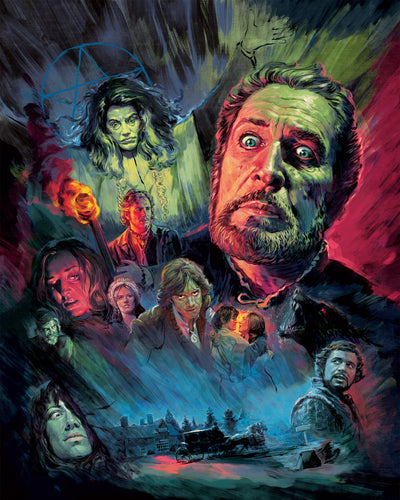
When Hammer Presents was unveiled back in December, the team promised an eclectic range that would excite and possibly surprise fans of horror. Sure enough, it’s already delivered gems like Cry of the Banshee (1970) and overlooked treasures including Doctor Blood’s Coffin (1961) and The Snake Woman (1961). But the next film in the range represents the most controversial, daring and downright horrific to date. It’s a movie that somehow contrives to be simultaneously baffling, bizarre and brilliant. It’s dreamlike. It’s nightmarish. It’s Murders in the Rue Morgue (1971).
When Samuel Z. Arkoff, one of AIP’s co-founders and most powerful execs, tasked Gordon Hessler with directing a version of Edgar Allan Poe’s famous short story, The Murders in the Rue Morgue, the first thing Hessler declared was, as he later recalled, ‘You can’t make that film!’ He felt a straight retelling was out of the question because the original tale, published in 1841, and Universal’s 1931 big screen version, starring Bela Lugosi, had become too familiar to audiences. ‘It’s a detective story,’ he reasoned, ‘and once you know the denouement – a monkey did it! – it’s over.’
But AIP had already pre-sold the movie and besides, it’s clear Hessler welcomed the challenge of crafting something new, edgy and innovative. ‘I think what we contributed to the horror film,’ he reflected, ‘was to move it up another stage from what it was… because picture making was very static at the time.’
Static? The month Murders in the Rue Morgue was released, Alfred Hitchcock started shooting the most extreme thriller of his career, Frenzy (1972), and over in the US, Francis Ford Coppola was busy directing The Godfather (1972), a classic which, at the time, was considered ground-breaking but highly contentious. Just a few months earlier, one of cinema’s most subversive fantasies, A Clockwork Orange (1971), had opened in the UK, scandalising critics and raking in over $100 million at the box office, whilst other wildly controversial pictures premiering in ’71 included The French Connection, Dirty Harry, Get Carter and Straw Dogs. The fact Hessler considered moviemaking to have become ‘very static’ during this period indicates how far he wanted to push the cinematic envelope, and his audacious take on Poe’s relatively gentle mystery forms the extraordinary result.

The Poirot auditions were down to the final three hopefuls… (l-r) Jason Robards as Cesar Charron, Peter Arne as Aubert, and Adolfo Celi as Inspector Vidocq.
Many films have a few minutes where accepted cinematic principles, narrative convention and, indeed, reality itself are all put on hold. Murders in the Rue Morgue has a period where this happens. It’s called Murders in the Rue Morgue. The entire thing is a fireworks display of ideas that explode and burn brightly, and although they might lack continuous cohesion, it doesn’t matter too much, because the overall effect is so startling, unpredictable and captivating.
The story the film tells sounds simple enough. There’s a serial killer on the loose in Paris during the early 20th century. He - or she - is targeting theatre folk, and the authorities put the great Inspector Vidocq on the case, whilst Cesar Charron, a successful stage actor/manager is also searching for the culprit. One problem: their prime suspect is dead and (literally) buried, which seems to give him an unbreakable alibi…
So far, so conventional. But don’t be fooled. Director Hessler and the writers, Christopher Wicking and Henry Slesar, enhance the plot with an avalanche of other elements, helpfully listed by reviewer Colin Newton, who ticked off the ‘wealth of Gothic tropes’ that are sprinkled into the mix: ‘Seriously, this film’s got… a haunted house; insanity; premature burial; return from the dead; prophetic dreams; death by acid; death by axe; death by ape; the Grand Guignol; sleeping draughts; doomed romance; vengeance; random fainting; a family mausoleum; Grecian columns; a guy who married his old flame’s daughter…’

Murders in the Rue Morgue was double billed with another AIP horror movie, The Return of Count Yorga (1971).
But, as critic Jonathan Lewis noted for Mystery File, ‘At the end of the day, however, it’s not the convoluted murder mystery plot that makes Murders in the Rue Morgue worth watching. Rather, the film is more an exercise in style and reflective of a certain type of Gothic horror cinema, one in which dreams, flashbacks, and hallucinatory sojourns play important roles in elucidating how the characters’ pasts and presents converge in tragic ways,’ adding that the movie was ‘the product of a certain type of daring’.
To be fair, the plot may be busy, but it zips along and we’re never too many minutes away from a gruesome set piece and another twist to keep the audience guessing. Hessler claimed he considered it to be ‘pulp fiction’ and some of his shots are so outrageous it’s hard to disagree. But to an extent that’s what makes the experience so engrossing. A lot’s been made of the film’s ethereal qualities but it’s also bursting with bold moments, such as one character rising from his own grave, and an ingeniously revealed murder on a carousel.
Herbert Lom, who plays the elusive Marat, had a career that stretched over 60 years and included some great roles in Hammer productions, such as the cruel and sinister puppet master in Whispering Smith Hits London (1952). But it could be argued that his most memorable onscreen moments are to be found in this work. No wonder Oscar-winner Jason Robards, who plays Cesar Charron, knocked on Hessler’s door a week into the shoot and asked if he could change roles and portray Marat as he was ‘much more interesting’.

Herbert Lom, seen here in Murders in the Rue Morgue, was on something of a horror roll. He’d recently played Van Helsing in Count Dracula (1970) and would soon after appear in Asylum (1972), directed by Roy Ward Baker.
It was too late to make the swap, which ultimately proved fortunate. The plot is so outrageous it needs someone as steady and overtly reliable as Robards at its centre. Herbert Lom, meanwhile, semi-reprises the role he first played in Hammer’s The Phantom of the Opera (1962) and Marat shares the Phantom’s aesthetic, as well as some of his motivations, tragic flaws and background. Lom is superb throughout, at times going for nuance and pathos, then letting rip during action-packed sequences. He may not have been chewing the scenery during the film’s finale, but he certainly gives it a good nibble.
The cast also includes the wonderful Lilli Palmer as ‘Madeleine’s Mother’. A former cabaret artist and star of the actual Moulin Rouge, she brings a welcome authenticity to her role as a seasoned veteran of the Paris stage, and her rapport with Lom’s tragic but terrible Marat is one of the piece’s highlights. Adolfo Celi, now best remembered as the villain of Thunderball (1965) is good value as the pragmatic Inspector Vidocq and Michael Dunn is suitably enigmatic as Pierre Triboulet.
Hessler and cinematographer Manuel Berenguer make excellent use of Toledo, Spain, where the picture was shot, and the score by Waldo de los Ríos is an offbeat treat – haunting, wistful and eerie.

Former ballerina Christine Kaufmann brought poise and elegance to the crucial role of Madeleine.
But watch Murders in the Rue Morgue today and, fabulous as they all are, it’s not the stars, setting or score that make it feel special. It’s the mood that Hessler gives the story. The dreamlike qualities that pervade it, so at times it’s deliberately unclear whether we’re witnessing a premonition, flashback, fantasy, or a depiction of part of the story that’s unfolding on the stage itself. It’s both unsettling and invigorating.
When AIP execs viewed Hessler’s version of the film they assured him he wouldn’t have to implement any changes, but they didn’t mention they’d be making a boatload themselves.
It should be immediately stressed that it’s often a good sign when the studio in charge of a production loathes it. Whilst Francis Ford Coppola was shooting The Godfather, for instance, Paramount hated the way it was going to such an extent that they were eager to replace the director, its lead, the score’s composer, and pretty much anyone else they could think of. Coppola kept his nerve and apparently it didn’t turn out to be a bad little film. Sherlock Holmes and the Voice of Terror (1942) horrified Universal, who barred the director from future entries in the series and held back the finished work, which eventually emerged as a gripping and truly chilling fan favourite.
Sometimes, of course, the studio succeeds in changing the movie and manages to release a version that’s markedly different than the director intended. 1992’s Alien 3 (aka Alien³) is an obvious example, along with The Magnificent Ambersons (1942) and Once Upon a Time in America (1984).
Murders in the Rue Morgue belongs to this honourable roll call of films that freaked out the studio bosses, and it’s easy to see why. The lack of clarity, the directorial flourishes and narrative richness makes Hessler’s version an outlier. As with one of his other works with AIP, Cry of the Banshee, there aren’t many characters you can root for. But unlike Banshee the storyline is playfully, and quite purposefully, oblique. The studio’s edit attempted to address these concerns, but Hessler was horrified by what he felt was damaging over-simplification. He wrote a lengthy letter to the AIP high-ups but accepted that it was too late and their version of Murders in the Rue Morgue - and not his - played in cinemas after debuting on July 21, 1971.

Michael Dunn remains best known for playing Miguelito Loveless in the popular 60s TV series, The Wild Wild West. The character was reimagined for the 1999 big screen version in which he was portrayed by Kenneth Branagh.
The fact the ‘original’ Murders in the Rue Morgue survived allows us to enjoy both versions, and, although they have their undeniable strengths, the question as to which constitutes the superior cut remains a matter of personal opinion. However, as both iterations are included in this Hammer Presents release, watching them in quick succession offers a fascinating insight into the process of filmmaking and the power of the edit. How we feel about the protagonists shifts, and our reaction to the close of their stories differs dramatically. It’s also instructive to gauge the ‘fright levels’ achieved by both versions, and to see how the tension is tightened using differing techniques.
Murders in the Rue Morgue has been painstakingly restored by Hammer in 4K from the original film negatives and the release also includes an archive interview with Gordon Hessler, a new commentary by author, filmmaker and horror film fan Chris Alexander, an interview with author and film critic Kim Newman, and the original theatrical trailer and an image gallery.
Almost inevitably, the film received a genuinely mixed reception from reviewers during its initial run. While some panned it and some praised it, subsequent generations of critics have fallen under its spell. Writing for Midnight Only, Jeff Kuykendall put its achievements into context: ‘…as Gothic horrors tried to find relevant means of expression against the tide of more explicit and harder-edged horror films, it’s an example of a thoughtful, and at times experimental, response.’
Arthouse horror or pulp fiction? Grim shocker, or romantic elegy? With this comprehensive release from Hammer Presents, you can finally judge for yourself.
Murders in the Rue Morgue is now available on pre-order, and joins Hessler’s earlier work, Cry of the Banshee, in the Hammer Presents range. Fans of AIP should also check out The House of Hammer: Volume 1, which contains the first part of a new documentary on the legendary studio.