

- Article
Coming Soon: X the Unknown
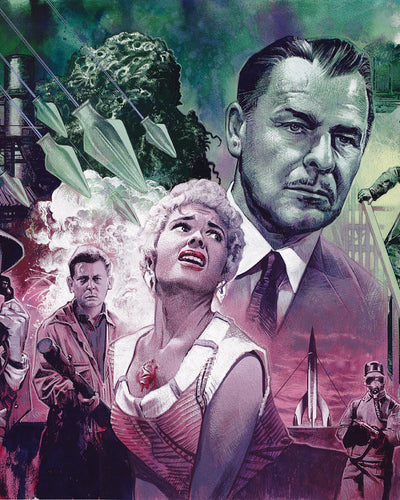
We’re delighted to confirm that the next release in our Limited Collector's Edition range will be the science-horror, X the Unknown (1956). If you’re a fan of the Quatermass franchise, 50s thrillers with a fantastical twist, or Hammer horror in general, this one’s for you! Aside from being a rattling good movie loaded with action and suspense, it represents a hugely important step in Hammer’s evolution into a powerhouse of the horror genre.
We caught up with Steve Rogers to discuss this exciting addition to the range…
Hammer News: Great to see you again! And particularly good to be back for this one – a slice of real Hammer magic. For anyone who’s never watched X the Unknown, can you give us a brief (spoiler free!) overview of the story it tells?
Steve Rogers: Some workshy National Service squaddies encounter a bottomless crack in the earth's surface that blasts them with deadly radiation. Dr Adam Royston of the handily local Atomic Energy Commission is despatched to investigate.
HN: Would it be fair to say it’s in the tradition of post-war British thrillers which are all about the Cold War, without actually being about the Cold War?
SR: Only inasmuch as Them! and The Quatermass Xperiment can be retrospectively assessed to have a Cold War influence. Everything made is a product of the time at which it was made – and East vs West tensions were running high by the mid-1950s. But if you'd asked Jimmy Sangster whether his script was stuffed with Cold War subtext he would have laughed at you and told you that it's just a story about a rampaging blob monster.

A kiss before dying? Promotional material showing Harry and Zena (Neil Hallett and Marianne Brauns) moments before their relationship hits a bit of a snag…
HN: Before I ask about the film’s background, I’ll put my cards on the table and say I genuinely love this movie, probably more than Quatermass 2 (1957). Is that heresy? The opening scenes draw the audience in immediately. The characters feel so authentic, right down to the Major who rocks up with the moustache and fabulous coat, and the suspicion is he’s going to stand around mogging whilst everyone else does all the hard work - but then he’s the first one who recognises the initial danger. The minor situations and relationship dynamics all feel so relatable, and the way the threat grows and is slowly revealed… Brilliant. Amazing to think this was the first feature film that Jimmy Sangster ever wrote. All of which is a preamble to me asking: in what way is this a typical Sangster script? And what elements does he manage to get so right in his debut feature screenplay?
SR: It may be the first feature that Sangster had written, but he'd been working at Hammer for nearly a decade by this point and had many productions under his belt – he knew only too well what worked in a script and what didn't. Where the genius comes in is what he did with that knowledge.
In X we see his first use of cheeky subsidiary character interplay to move the plot forward, children in deadly peril, pitch black humour, reasonably ineffectual police and, as David Kalat points out in his commentary, the nexus point where Hammer Horror began. I won't spoil it – just listen to the commentary and you'll go “of course!”.
HN: Let’s address the Professor in the room… It feels very Quatermass! Could you take us back to the mid-50s and trace the film’s origins?
SR: It feels very Quatermass because it was intended to be Quatermass. After the success of Xperiment, Hammer fast-tracked a new science-horror story and latterly asked Nigel Kneale for permission to use his character, which he refused. So, they changed the name from Bernard Quatermass to Adam Royston, kept calm and carried on. The irony is that Royston's character is much more aligned to Kneale's vision of Quatermass and not the Donlevy film version, which was one of Kneale's more significant gripes regarding Hammer's Quatermass adaptation.

Even the aesthetics of the posters used for X the Unknown are reminiscent of the promotional imagery previously seen for The Quatermass Xperiment.
HN: I read that when it played in the UK, it was on a double bill with Les Diaboliques (1955), also known as Diabolique. That film is now rightly regarded as a seminal horror/mystery that clearly influenced directors like Hitchcock and François Truffaut, whereas X the Unknown is equally strong in many respects, but doesn’t enjoy the reputation of Les Diaboliques. Is that a fair comment? And if so, why do you think it’s the case?
SR: Diabolique’s enhanced reputation is a relatively recent thing as far as this country is concerned. When it first appeared in cinemas it was a smash on the Continent and in the US, but much less so in the UK. “Horrid”, “sordid” and “a disappointment” are some of the more fun reviews it got when it played in UK cinemas as The Fiends – whereas Kine Weekly called X a “first-rate British shocker” and spent several column inches over the next few weeks telling the world how the double bill was cleaning up at cinemas around the country. Does that mean one film is better than the other? No, but it does show that labelling a film a ‘classic’ is a moveable feast.
HN: The central character, Doctor Royston, is played by Dean Jagger, making his sole Hammer appearance. What can you tell us about Jagger in general, and what he brings to this role in particular?
SR: Jagger was an Oscar-winning actor who had built a career on giving strong-but-subtle performances. Here he veers more towards the subtle end, making his Royston character less mono-maniacal – and certainly less bullish – than Donlevy’s Quatermass. It is a rare skill, however, that can make an absent-minded, empathic, woolly hat-wearing scientist into a highly memorable lead, but Jagger does it with ease. It’s quite disappointing that they didn’t make any sequels.

Frazer Hines as Ian (right), seen here with Dean Jagger. The following decade Hines landed the part of Jamie McCrimmon in Doctor Who, a role he’s played, on and off, for over 50 years.
HN: The rest of the cast is one ‘Look who is it is!’ treat after another. From Kenneth Cope being quietly but typically Kenneth Cope, to Leo McKern, Frazer Hines and even Dodger himself – Anthony Newley. Who stands out for you, and why?
SR: Newley and Ian MacNaughton as Sangster’s “Greek chorus”, Spider and Haggis. Not only are they superb extended cameos but, though neither of them knew it yet, both men would change the face of television comedy at either end of the 1960s: Newley with The Strange World of Gurney Slade and MacNaughton with Milligan’s Q5 and Monty Python’s Flying Circus.
HN: Aside from his work on The Lost Continent (1969), I think this was the only production Leslie Norman directed for Hammer. Why was that?
SR: Because, according to many reports, he was not the easiest fellow to get along with. For X he took over from Joe Losey a few days before principal photography started, was very unhappy about the situation, and made sure that everyone knew it. He left partway through production on The Lost Continent for pretty much the same reason. Do not confuse the man with the art, though – Norman was a superior craftsman and turns in an exceptionally well-directed film with X.
HN: Can you highlight one or two of the things he absolutely nails with this work?
SR: The mounting sense of dread is quite palpable in some scenes – again, no spoilers. But Norman is equally adept at letting the camera linger on small character moments, especially the first time we meet Royston in his laboratory. A lesser director would have sped through that scene, but he allows the pace to dawdle here as a counterpoint to the steadily building crescendo that follows. It’s an eighty-minute film, paced perfectly, and exactly as long as it needs to be.

Behind the scenes… The master make-up artist, Phil Leakey (right), has a brush with Edwin Richfield. The latter went on to have more significant roles starring in Hammer classics such as Quatermass 2 (1957) and Quatermass and the Pit (1967).
HN: I know that as is usual for films in the Limited Collector’s Edition range, X the Unknown has been restored in 4K. But what else can we look forward to with this release?
SR: Both UK and US versions of the film, a slew of commentaries, some new programmes on the making of the film, Joe Losey, and special effects maestro Les Bowie, Sangster and Losey’s short film A Man on the Beach, a 120-page book, and much more.
HN: I’d like to ask you a bit of a ‘what if’ question, if that’s all right? In hindsight, we can clearly chart Hammer’s post-war trajectory - from a studio producing outstanding B-movies, predominately thrillers, to one which had such a seismic effect on the horror genre throughout the late 50s, 60s, and beyond. But if X the Unknown had been given to a different writer and had somehow flopped, or if it hadn’t been quite the success it proved to be, do you think Hammer’s journey would have taken a different path?
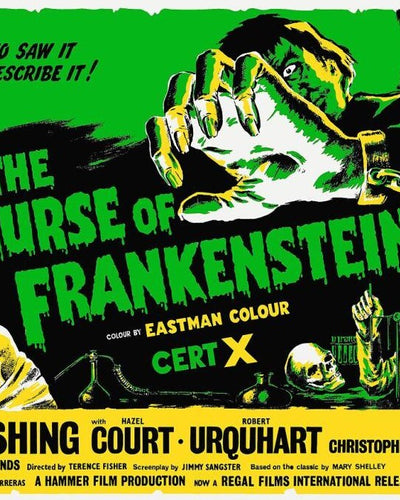
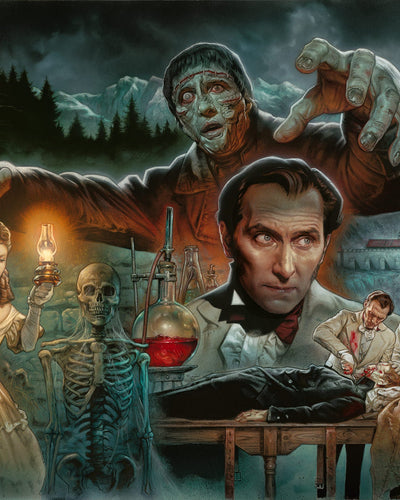
SR: No, because by the time X was on release in November 1956 they had already written, cast and were about to start filming The Curse of Frankenstein. No-one knew it at the time, but the blue touch paper had already been lit. What is disappointing in retrospect is that the global success of the Gothics immediately derailed any development of further science-horrors following X and Quatermass 2 – both superb thrillers. One can only imagine what would have come next if Frankenstein hadn’t set the world on fire.

Royston demonstrates a Quatermass-like brusqueness in this scene (‘Your son has been badly burned!’) but one of the parents will have their say as the drama unfolds…
HN: And finally… leaving aside the movie’s importance within Hammer’s development and its genre in general… For people sitting down to watch X the Unknown for the first time – what do you think they’ll love about this film?
SR: All of it – from the characters and the direction, right through to the ambiguous ending. In another dimension the science-horrors would have co-existed with the Gothics and X would have had several sequels and a Quatermass crossover – and Hammer Horror would have had a completely different meaning.
Big thanks as ever to Steve Rogers for sharing his time and insight.
X the Unknown is now available to pre-order, and fans of science-horror can explore Hammer’s Quatermass Collection which, in addition to the films, also includes posters and other essential merch.
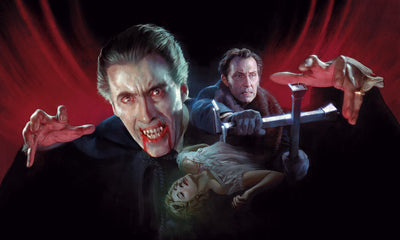
Finally, if the Q&A above has whetted your appetite for other films written by Jimmy Sangster, you can pick up The Curse of Frankenstein (1957), Dracula: Prince of Darkness (1966), The Horror of Frankenstein (1970), Fear in the Night (1972) and the only movie he directed for Hammer that he didn’t write the screenplay for - Lust for a Vampire (1971).