

- Article
A Beginner‘s Guide to Vincent Price
Vincent Price has been hailed as ‘the King of horror’ and remains one of the genre’s most celebrated stars. The fact he never appeared in a Hammer movie has always seemed like a strange and reluctant quirk of cinema. These two titans of terror feel like such a natural pairing that it’s entirely appropriate he’s finally entering the Hammer House of Horror courtesy of Cry of the Banshee (1970), the first movie released in the fledgling Hammer Presents range. To celebrate his long overdue arrival we’re taking a whistle-stop tour of his life and career. From saint to sinner, witchfinder to kitsch fraudster, his roles were wildly varied. But in terms of delivering astonishing twists, none came close to his adventures in real life. This then, is a beginner’s guide to Vincent Price.
In many ways Cry of the Banshee represents a typical Vincent Price movie. It’s got supernatural horror, witch hunts, vengeance and extreme villainy in pretty much every scene. And it places the great man himself at its centre as the murderous Edward Whitman - a person so relentlessly cruel he makes audiences root for the demonic forces summoned to put him in his place.
Kine Weekly observed at the time, ‘Vincent Price as Lord Edward, is, of course, well in command of his own special cinema territory’ and more contemporary reviews have been equally fulsome. Horror Asylum recently pointed out ‘…horror legend Vincent Price gives a supremely sinister performance as a despotic Elizabethan magistrate’ and in 2021, writing in Eye for Film, Jennie Kermode enthused, ‘Most importantly, though, there is Price… he effortlessly commands attention, making every scene in which he appears his own… Cry of the Banshee sees him on good form.’

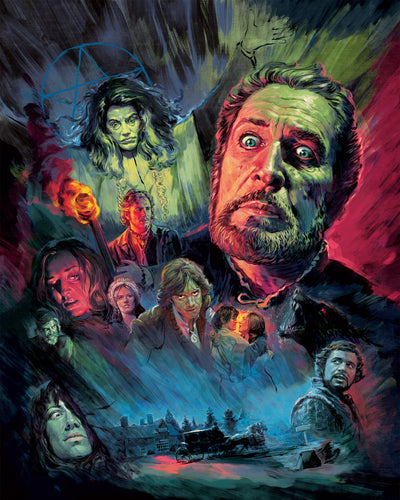
New artwork for Cry of the Banshee. The director's cut, together with AIP’s re-edited theatrical version, are available now as part of the Hammer Presents range.
He may have been on good form, but is it a typical Price performance? In a chapter devoted to his work in a 1998 book called, simply, Vincent Price, Susan Svehla argues, ‘he turns in his usual professional performance… but the grisly script kept any lightness at bay’. She laments, ‘there is no opportunity for Price to bring that distinctive voice into play and use those delightful witty intonations that put the spark in his other characters… There is no humanity [in Lord Whitman] … and Price plays the role that way - low-key and evil.’
Reviewer Mike Perry is more direct when discussing the film. He acknowledges Price makes ‘a great villain’ in Cry of the Banshee but admits he prefers his acting when it’s done, ‘as if he’s in on the joke with a slice of ham on the side’.
Some might feel it would be slightly unfair to criticize Price for taking the role so seriously. His approach ensures this is a hard-hitting work and, if Whitman had emerged as a more pantomimic character, the whole tone and tension of the narrative would have been wrecked. It’s certainly hard to imagine, for instance, Quentin Tarantino programming the movie for his inaugural QT-Fest back in the late 90s if Price had camped up the central character.
Besides, if you’re after Price in more OTT form you’ve got plenty of options. The Abominable Dr. Phibes (1971) is a fabulous, full-blooded piece of horror that sees Price at his theatrical best. It also proved to be a turning point in his career. He’d already demonstrated he could play horror to a tee, but as critic John E. Parnum pointed out, ‘…with the Phibes films Price showed that he could successfully blend giggles with his ghoulishness.’
James Robert Parish and Steven Whitney were astute when they stated in Vincent Price Unmasked that, ‘More than anything, the movie [The Abominable Dr. Phibes] served to bridge Price’s screen image from the Poesian figure of the 1960s to the mock-horror figure of the 1970s, with the on-camera character generally as much to be pitied as to be abhorred.’

© 1971 Metro-Goldwyn-Mayer Studios Inc. All Rights Reserved.
The first Phibes film was followed by Dr. Phibes Rises Again (1972), and both have become cult classics. Theatre of Blood (1973) is another winner from the early 70s and sees him playing (in his words) ‘…an old Shakespearean ham actor… I don’t win the Critics’ Circle award, so to get even with them I kill off all the critics – one by one, each one according to a play [by] Shakespeare.’ It’s as cooky (and as fun) as it sounds, and Price benefits hugely from a terrific supporting cast that includes Robert Morley, Diana Rigg and Michael Hordern. (Price was quick to praise them and called his co-stars, ‘twelve of the best actors in England.’)
Ultimately, these three films partially defined Price. His performances work because, in each instance, they both fit the tone of the film and help establish it. He makes flamboyance look easy; he handles the horror with gusto and guile – castigating and killing as though his character owns a divine right to vengeance – yet somehow, he can still elicit our sympathy. Many have dismissed Price as ‘hammy’ in roles like Phibes, but there’s a rare skill in such extravagant portrayals, and Vincent Leonard Price possessed it in spades.
It therefore comes as a surprise to learn that he seems to have become an actor almost by accident. He later recalled, ‘… [After] I graduated from Yale, I taught school for a year. Then, I had that extraordinary experience of finding out that I knew nothing. Those little kids that I was teaching knew a lot more than I did. So, I went to get my master’s degree at the University of London, and there I fell in love with the theatre, which was very easy to do in England…’
He was probably being modest, but he occasionally claimed that starting out he was able to win several apparently inconsequential parts in London’s theatreland thanks to his American accent. But his big break came in a small venue. After some very minor roles he was cast as Queen Victoria’s husband, Prince Albert.
‘I started in a little theatre, called the Gate Theatre… there I first did Victoria Regina, which was a great success, but in a tiny little theatre, that only held 100 people. Then, when [producer] Gilbert Miller brought Victoria Regina to do in New York with Helen Hayes, I came along [and] I played in it for three years, starting the day after Christmas in 1935. It was a very exciting experience, to be the leading man to the number one actress in America, at the time.’

Vincent Price (seen here in Cry of the Banshee) learnt to think in German for his performances in Victoria Regina.
Price never forgot his debt to the production and even named one of his children Victoria after the play. He often credited Hayes for ‘showing him the ropes’, and the high-profile hit on Broadway resulted in several more stage successes. He soon made his big screen debut in Service de Luxe (1938), but his first major triumph in a prominent role came six years later, starring in the classic noir thriller, Laura (1944), directed by Otto Preminger.
Between 1947 and ‘51 he played Simon Templar in The Saint. This hugely popular radio series made the most of Price’s unique voice, and he clearly enjoyed the medium, both acting in and presenting radio shows across the world throughout his career, including an acclaimed adaptation of Nineteen Eighty-Four for the Australian version of Lux Radio Theatre in 1955.
Although he appeared in a number of horror features prior to the ‘50s, his performance in House of Wax (1953) forever linked him with the genre. It’s an atmospheric melodrama in which Price plays Professor Henry Jarrod, an artist who keeps his wax museum well-stocked with people he’s murdered and given a grisly glow up to, in order to make them resemble waxworks – like you do. Awash with histrionics and clearly implausible, it found favour with some critics (‘This picture will knock 'em for a ghoul’ - Variety) whilst others pooh-poohed it. Despite the mixed reactions, it became a hit due in part to what Slant Magazine called, ‘Vincent Price’s scintillating central performance’.
It’s often cited as being the first 3-D film made by a major studio and, when it debuted at the Downtown Paramount Theatre in LA, it opened with a ‘round-the-clock premiere’ comprising twelve screenings, starting with a midnight ‘spook premiere’. 3-D movies never really took off, but Price’s career in horror finally went stratospheric.

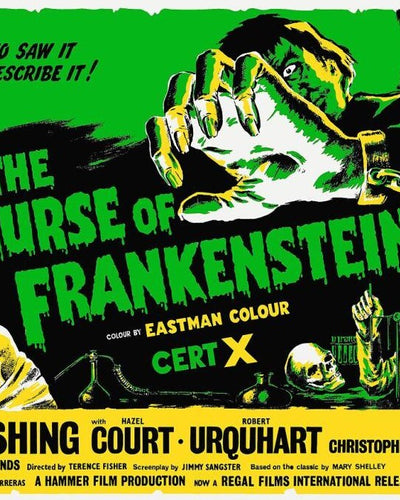
Marketing material for Cry of the Banshee.
Much later he claimed that Cry of the Banshee was his 100th movie and that, up until its release, only a dozen or so of his others had been horror films. Whilst the arithmetic behind the assertion is open to a degree of doubt, the underlying point that he was making seems sound. His work in horror eclipsed his efforts in other genres, including the comedy, Champagne for Caesar (1950) the Biblical blockbuster, The Ten Commandments (1956) and the sci-fi tour-de-force, The Last Man on Earth (1964).
The problem is obvious. When your acting resume is chock-full of horror classics such as The Fly (1958), House on Haunted Hill (1959), Witchfinder General (1968), House of Usher (1960), The Pit and the Pendulum (1961) and The Masque of the Red Death (1964), the glare of their brilliance inevitably blinds many to the worth of other works.
Speaking of which, his television output ensured he had two stars on the Hollywood Walk of Fame - one recognising his achievement in films, and the other acknowledging his contributions to the small screen. The latter included an entertaining cameo in the 1973 Columbo entry, Lovely But Lethal, and a fabulously outrageous interpretation of Egghead, a recurring villain in the 1960s Batman series starring Adam West as the Caped Crusader.

‘I’m glad I worked with him, in the same way I’m glad I worked with DeMille.’ – Price on Alfred Hitchcock (above).
But before those turns, he worked with the ‘master of suspense’ on a 1957 episode of Alfred Hitchcock Presents. The Perfect Crime was one of the relatively few that was directed by Hitch himself, and it remains an absolute treat. Price expressed disappointment that they never collaborated on a movie but was gracious about the director (‘I liked him a lot’), despite some on set absurdity. Recalling an incident during an interview with Lawrence French, he explained The Perfect Crime involved, ‘… two men talking about a murder, with Jim Gregory accusing me of doing it. There was one point where we looked over at Hitchcock in one of the run-throughs, and he was sound asleep, or else he was pretending to be sound asleep!’ Laughing, he assured his interviewer, ‘He did that all the time! He did it with Cary Grant, he did it with everybody. It was part of his routine, or his image.’
Aside from film, television and radio, Price continued to appear in stage productions, achieving his most lauded success in the late ‘70s, starring as Oscar Wilde in Diversions and Delights, a one-hander written by John Gay. The production played on Broadway and across the States, winning rave reviews. The New York Post called the show, ‘A delight, witty and moving’, Variety agreed, stating, ‘Vincent Price is a “Wilde” delight’, whilst the Wall Street Journal said what everybody already knew: ‘Vincent Price is a master’.
Away from the world of performing, Price’s passion for artworks never waned. He believed fervently that access to them should be for everyone and donated (literally) thousands of pieces over the course of his lifetime, ensuring they could be enjoyed by more than a group of private collectors and their friends. It’s a joy to watch any interviewer ask him about art – he becomes animated and almost evangelical with his responses, talking knowledgably but without pretension.
There are many more layers to the man. His involvement with pop videos - which he saw as a way of reaching out to new generations of audiences - and his love of cookery (he was a gourmet chef who co-authored books on the subject), are just two more elements in his already-packed story.

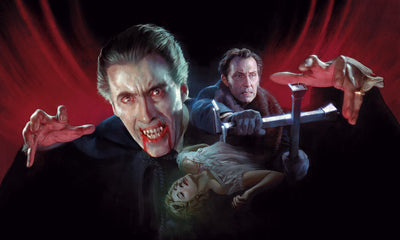
New artwork depicting Price (right) together with Christopher Lee (left) and Peter Cushing.
In later life he mentioned a few regrets, and expressed disappointment that he’d not played more Shakespearian roles. But according to many who knew him, he remained sanguine about supposedly becoming typecast in horrors, and he certainly didn’t have a problem playing villains. ‘The hero is so dull,’ he once commented to Johnny Carson, and in the same interview expressed relief that he’d managed to play such varied characters.
Thanks to Hammer Presents, one of those characters, evil Edward Whitman from Cry of the Banshee, is once again enthralling audiences, with many viewers perhaps new to this more serious side of Price’s range. But does it truly matter that he’s now a member of Hammer’s extended family? Maybe not. But it feels like Flickering Myth, when reviewing Cry of the Banshee, were spot on in their assessment: ‘Overall, it is a treat to have one more Vincent Price-led folk horror in 4K UHD… and having Price’s face on the cover of a package that also has the Hammer logo on it feels like something special…’
‘Something special.‘
That just about encapsulates both the situation, and Vincent Price himself.
Cry of the Banshee is available now, along with other titles in the new Hammer Presents range. Keep an eye out for more additions to the collection in the near future.
And, if you’re after more Vincent Price material, The House of Hammer: Volume 1 - the first in Hammer’s new multi-format series - is for you! It includes Masques, Monsters and Madmen - Part 1 of a new, feature-length documentary about AIP, the studio that produced some of Price’s finest films. And the accompanying book features new articles on the making of Cry of the Banshee, Roger Corman’s ‘Poe Cycle’ of films, plus a revealing archive interview with Price himself. Unmissable!