

- Article
Dracula: The Legacy
Hammer's Dracula (1958) isn't simply one of the greatest horror movies ever made, it's amongst the most influential British films of the twentieth century's post-war period. Many other UK productions cost more. A fair few made more. But in terms of legacy – to genre, cinematic storytelling and what was deemed possible on the silver screen – it represents the gold standard of gamechangers.
In this feature we're focussing on two key elements of that legacy, examining how Dracula hit 'reset' for filmmakers' depiction of both heroes and villains. So, dab a splash of holy water behind your ears and grab a garland of garlic as we investigate how Christpher Lee wound up at the Bates Motel and ask, did Peter Cushing really just invent Indiana Jones?
It's widely accepted that Hammer's Dracula transformed the firmly entrenched perception of its celebrated antagonist. When Christopher Lee descended that long, stone staircase in his first scene as the Count, he wasn't simply stepping into immortality, he was redefining how the public would forever view the world's most famous vampire.
Bela Lugosi's Dracula had previously provided the template for how the character was understood and unthinkingly accepted. All accent, eyeliner and big cape action. Todd Browning's Dracula (1931) is a fabulous work and Lugosi was, in his pioneering, dawn of the talkies kind of way, brilliant as the lead, but if his performance had been any stagier he'd have been taking bows after every scene.

The full-on nature of Hammer's Dracula (released in the US as Horror of Dracula) proved too much for some reviewers. The Daily Worker's Nina Hibbin was not alone when she declared, 'I came away revolted and outraged…'
Christopher Lee, screenplay writer Jimmy Sangster and director Terence Fisher shot for a kind of fairytale authenticity, instead. 'It's a fantasy,' The News Chronicle noted in its review, adding that the adaption was, 'for the most part, rooted in the sort of realism which comes of everyone taking it and themselves quite seriously.'
That realism brushed aside the theatrics and made the Count someone who's closer to the audience in many unmissable ways. Of course, this version brought the heightened, overt sexuality and magnetism, but never at the expense of the character's intrinsic malevolence. As authors Alain Silver and James Ursini point out in The Vampire Film, 'Lee's interpretation has restored the demonic and bestial aspects of Dracula, lacking in the Universal pictures, without diminishing the cunning and evil intelligence of the character. This Dracula possesses a primitive and instinctual dynamism… he manages to create an aura of menace with his limited presence that hangs over the whole of the various films [he appears in].'

Peter Cushing alongside Melissa Stribling who plays Mina. Writing for The Consulting Detective, Nick Cardillo noted '[Melissa] Stribling's performance adds an unnerving note of sensuality to the film.'
So, what does Hammer's new Dracula bring to the party? Allure, eroticism and a feral depravity? Check, check, check. But he also introduced something much more important that's often overlooked.
He brought normality.
Consider Bram Stoker's original concept of Dracula, given in Chapter 2 of the novel where Jonathan Harker describes him as, '…a tall old man, clean shaven save for a long white moustache… [He had] peculiarly arched nostrils, with lofty domed forehead, and hair growing scantily round the temples but profusely elsewhere. His eyebrows were very massive, almost meeting over the nose, and with bushy hair that seemed to curl in its own profusion… For the rest, his ears were pale, and at the tops extremely pointed.'
Yikes! He's not exactly Leatherface, but even so, you'd still hope he kept walking if you saw him strolling down your train carriage. Likewise, the Dracula figure in Nosferatu: A Symphony of Horror (1922) is a grotesque-looking, rodent-like ghoul, and although Lugosi's Dracula doesn't come close, he still loads his version with characteristics which, as discussed, instantly mark him down as unusual to say the least.
But Lee's Dracula – initially and ostensibly – is the best of us.
This obliging host helps you with your luggage, invites you to treat his home like your own, apologises when he really has no need to do so, and even takes the time to compliment your professional experience. In short, he's a bundle of social niceties and surface level affability presented in a tall, dark and handsome package. His voice is rich and sonorous but never bizarre, and he manages to avoid saying things like, 'Listen to them. Children of the night… What music they make!'
If Lugosi's Dracula is the 'other', then Lee's is the 'us'.
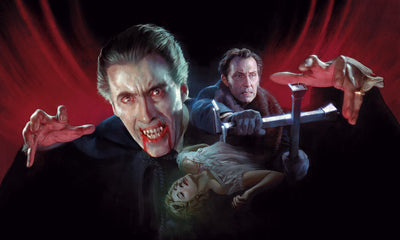
This becomes a vital element in understanding the importance and influence of Hammer's Dracula. Within the film itself it means the iconic (and much copied) 'attack scene', where the Count's true self is exposed, becomes one of the entire genre's most potent reveals. The metaphorical unmasking proves genuinely shocking on a visceral level, and comes as a swift, brutal rebuttal of Dracula's earlier apparent ordinariness as we're confronted with the vicious, blood-stained truth.

There's even a slight trace of a smile on Dracula's lips as he moves forward to greet his unfortunate guest.
But more than this, it powerfully shows that terror is more terrifying when it initially looks and sounds like us. In other British horrors of the time, from the B-movie schlock of Fiend without a Face (1958), to the sci-fi scares of The Trollenberg Terror (1958) and Hammer productions including Quatermass II (1957) and X the Unknown (1956), the adversary – that thing which is central to our fears – is demonstrably alien in both visual appearance and methodology. The inhumanity is clearly flagged by a monstrous demeanour. The 1958 Dracula, however, works with a daring anthesis of this paradigm. Here the 'monster' is at once repulsive and attractive; a chilling, killing hybrid of Baron Frankenstein and his creature.
As such he paves the way not only for future vampires, most obviously in pics such as The Brides of Dracula (1960), Bram Stoker's Dracula (1992), From Dusk till Dawn (1996) and Interview with the Vampire (1994), but for villains of a less supernatural nature exemplified by the likes of Norman Bates, the homicidal Mark Lewis from Peeping Tom (1960) and even Bob Rusk from Hitchcock's Frenzy (1972). Dracula is the work that rams home the revelation that the undead and other terrors can be undetectable. The evil we face is amongst us, seemingly innocuous, but ready to strike at any moment.

Lee revealed he attempted, '…to make the character all that he was in the book—heroic, romantic, erotic, fascinating, and dynamic.'
In some interpretations of vampirism, the undead are unable to create shadows. But in making his figure of horror a person who could easily pass for the audience-member sat next to you in the cinema, Christopher Lee still casts a long shadow across how we fear and expect villainy to be represented onscreen. It's an ingenious take on one of fiction's best-known myths, leaving a legacy of elegant evil not just for the lore of Dracula, but for the entire horror genre and thrillers right across the board.
The importance of how Dracula was revamped by Hammer often overshadows another great reimagining the movie delivers. Not only is the quintessence of wickedness repackaged for a new generation, we have a new and remarkably enduring kind of hero in Cushing's Van Helsing.
He represents the first of the true action-hero scientists/academics. As such, he not only brings dynamism to the role, but to the production in its entirety. The perfect nemesis for Lee's virile vamp, and a figure who makes the whole affair more accessible and well, fun! We'd seen intelligent men of action battling the forces of corruption in previous films, of course, most pertinently in The Quatermass Xperiment (1955), but this is the first time we've been given such an obvious and swaggering academic with attitude.
Brian Donlevy is terrific as Quatermass but he never really feels like a scientist as he blusters and bullies his way out of the problem the alien menace presents, and it's telling that in Quatermass 2 he's never actually referred to as a professor.

Peter Cushing reprised the role of Van Helsing in The Brides of Dracula. It would be the first of his many returns to the calling of vampire slayer…
Equally, earlier scientist heroes tended to resemble Dr. Zarkov from the Flash Gordon serials of the 30s and 40s. Descibed as 'a madman' and 'a dishevelled, wild-eyed figure' in the original comic strips, he typified the trope of the scientist sidekick. Brainy but useless in a scrap. Zarkov stands as the prime example of this: intellectually gifted he repeatedly left the rough stuff to the less scholastically inclined leading man, as if the capacity to solve quadratic equations and knowing how to throw a decent right hook were mutually exclusive.
In Stoker's novel, Mina describes Van Helsing as having '…big bushy brows… [His] forehead is broad and fine, rising at first almost straight and then sloping back above two bumps or ridges wide apart, such a forehead that the reddish hair cannot possibly tumble over it, but falls naturally back and to the sides…' He has a pronounced accent and his speech patterns are a quirky combination of languages. He's also prone to bursts of laughter, most notably straight after Lucy's funeral: 'The moment we were alone in the carriage he [Van Helsing] gave way to a regular fit of hysterics. He has denied to me since that it was hysterics, and insisted that it was only his sense of humour asserting itself under very terrible conditions…'
Cushing chose to ignore these visual and habitual oddities and the standard trope of the scientist hero, instead conjuring up a more modern, Holmesian Van Helsing. Ferociously intelligent, courageous and a seemingly unstoppable force of nature, and thankfully without the lowkey whimsey of say, Edward Van Sloan as Van Helsing, or the 'elderly eccentric scientist' vibes that John Gottowt gave whilst playing the character in all but name in Nosferatu: A Symphony of Horror.
He remains a man of science – questioning, reasoning and searching for the truth. But crucially, he fuses this bearing with a physicality that was new to the figure. Whether sprinting in pursuit of his quarry or matching his opponent blow-for-blow, this Van Helsing is the most astute, dashing and dynamic hero of his time.

'He was a wonderful actor, one of the finest I've ever seen. But as a person, not just as an actor, he was unique.' – Christopher Lee on Peter Cushing.
Cushing's Professor feels like the Indiana Jones of the vampire world. An academic who's at his best when divorced from academia; a deep thinker who nevertheless uses his brawn as readily as his brain. That final, famous showdown where he tears down the curtains, leaps onto the long table, grabs the candelabras and fashions them into a cross which he then brandishes in order to kill the Count, set the standard for future vampire hunters from Kristy Swanson as the eponymous Buffy the Vampire Slayer (1992), to Hugh Jackman's Gabriel in Van Helsing (2004).
Dracula created a new kind of villain but it also cemented the idea of the buccaneering boffin. When Van Helsing turns up in The Brides of Dracula we know we're in for fights and fireworks, and the hero he embodied has echoed throughout cinema ever since, a legacy of Dracula that's sometimes underappreciated due to the power of Lee's performance.
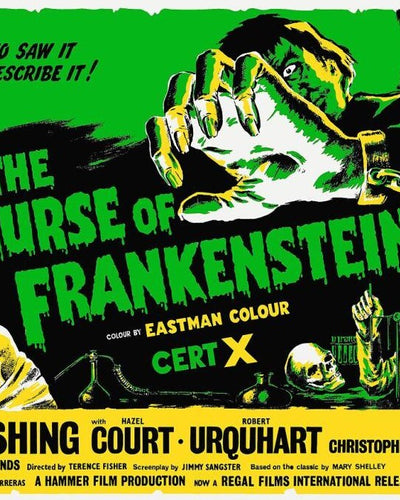
The movie's lasting influence, then, is largely down to Peter Cushing and Christopher Lee whose legendary friendship helped them forge one of fiction's greatest onscreen rivalries. Theirs was a partnership that seemed to be written – almost literally – in the stars. Cushing's birthday was the 26th May. As if magically planned so they could enjoy joint celebrations whilst respecting each other's special day, Lee's was the 27th May. In later years these icons of horror became laughing schoolboys when reunited, demonstrating an enduring respect and affection. Although they'd shared scenes in The Curse of Frankenstein (1957), Dracula established their most famous double act – the Count and Van Helsing, two figures who impacted on heroes and villains for decades after they first faced each other.
At the time of the movie's release, Hammer declared itself to be '…the company that's injecting fresh blood into the film industry'. And over sixty years later, just like the character of the Count, its legacy refuses to die as Dracula remains, as ever, part of the beating heart of horror.
Step into the crypt and explore Hammer's Dracula-related items, or check out The Curse of Frankenstein and the broader Frankenstein range at the online store.