

- Article
The Top 5 Femmes Fatales of Hammer Films… Part Two
In Part One of this celebration we remembered the femmes fatales who were frozen-hearted killers, manipulating and murdering for entirely selfish reasons. But now we’re rounding off our top 5 rundown with a look at the femmes fatales who are partially motivated by a desire for vengeance, striking back over perceived iniquities they feel compelled to redress.
They’re still deadly and devious, and you wouldn’t touch a cocktail they’d mixed for you, but perhaps can we empathise with them, just a little? Plus, we’ve a special bonus inclusion to round off our foray into the world of Hammer’s fabulous femmes fatales… And warning: there will be spoilers!
4. The Tragic Femme Fatale: Vanessa Mitchell from Spaceways (1953).
Spaceways is a curious hybrid, a noirish sci-fi thriller that manages to incorporate love triangles that become central to the narrative, cold war intrigues and a classic murder mystery complete with a quirky detective. It also subverts the figure of the femme fatale, giving us the marvellously malign Vanessa Mitchell, played by Cecile Chevreau. Normally, we encounter the female villain at the height of her powers, allowing her to become a credible threat and suitable foe for the (usually male) hero of the piece. But in Spaceways, we meet a rogue who feels forever thwarted, meaning that from the outset, there’s a sense of tragedy around this figure whose reckless plotting will end in bleak disaster.
We’re introduced to Vanessa at a ghastly party celebrating the achievements of Deanfield Space Centre, a governmental organisation that operates from an enclosed military base which boasts all the glamour and appeal of an ingrowing toenail. It quickly becomes apparent she’s married to Steve Mitchell, one of the organisation’s most important figures. People at the gathering – predominantly workers and their wives – are stood around grinning, except Vanessa and her illicit paramour, Philip Crenshaw, who sit on a corner sofa, with Vanessa half-heartedly stifling a yawn as a series of ‘thrilling’ announcements are made. Moments later another wife (older and plummier) joins her to enthuse about the dullness of life on the camp. She gabbles on about the ‘tedious passes and regulations’ and adds ‘I love every minute of it, don’t you?’
Vanessa spares her a perfectly weighted glance of contempt. ‘No, thank you, I loathe every minute of it,’ she replies. ‘And with every minute I loathe it more!’

Even when meeting her lover, as here, there’s a sadness to Vanessa which is impossible to ignore.
She might be impolite but it’s the first moment of rebellion in the movie and it’s impossible not to have a sneaking admiration for Vanessa’s spirit and refusal to conform. That evening she shares a brief ‘romantic’ assignation with Crenshaw and then heads home to her barracks-style accommodation, where she has a showdown with her husband. She’s discovered he’s received a job offer which would pay considerably higher wages, but he refuses to leave his current role, pointing out she knew what she was letting herself in for when she married him. ‘I never dreamt it would be like this,’ she snaps back, reeling off the things she hates about the strict security enforced on the base. ‘I can’t even choose my own hairdresser!’ she fumes, giving us a wonderful insight into her priorities.
But it’s difficult not to feel sorry for her. Yes, she’s having an affair, but Steve and his colleague, mathematician Lisa Frank, are forever making eyes at each other, and it’s obvious Vanessa is desperate for a freer, more opulent life. There’s also a fascinating sense that she’s committing her crimes as a kind of vengeance. As Tipping My Fedora observed, ‘Her affair with Crenshaw thus seems as much a rebellion against the claustrophobic confines of the facility as her husband.’ Vanessa is striking back not just at her husband, but everything he represents, from the environment she’s become enmeshed in, to the establishment she believes he represents.
She married Steve when his prospects looked good and he must have represented quite the catch. The handsome American destined to be one of the planet’s first astronauts. A square-jawed heroic type, only latterly transformed into one of the slack-jawed ‘slaves in white overalls’ as Vanessa describes his team. She rages at his loyalty to his employers and cites how her existence could be improved if he walked away from his position, even having the nerve to end her protestations with, ‘Oh Steve, I only want the best for us… for you.’
When her husband turns away she feels she’s left with no choice, and to escape the base she puts a plan into action that kickstarts the film’s main narrative thrust.

Cecile Chevreau (seen here as Vanessa in Spaceways) later returned to Hammer to play Joan Peterson in Five Days (1954), a thriller directed by Montgomery Tully and released as Paid to Kill in the US.
She essentially fakes her own death, thereby framing her husband for a murder that never took place. As relationship break-ups go, it’s fairly extreme, but when we finally catch up with her she’s still unhappy, on the lam with Crenshaw in a small, secluded house, or ‘a hole like this!’ as she brands it. He promised her America but instead she’s sussed out he’s defecting to ‘the East’. Despite his aggressive insistence that she must accompany him, she refuses and treats him with the disdain he deserves.
She’s also honest about her own motivations for leaving with him, ‘Deanfield was a prison and you got me out of that,’ she concedes, ‘[But] I’d be mad to change it for another prison, even if it has got 200 million people in it!’
Later, as Crenshaw holds her at gunpoint and gloats, she’s too classy to beg him for mercy. The detective in charge of the case arrives moments too late and yet again, Vanessa has been let down by a man. She starts the movie wanting to escape Deanfield and the life of restrictions her husband’s job has condemned her to, and on that level alone, she’s succeeded.
Vanessa Mitchell only appears in a few scenes in Spaceways but she’s such a vibrant figure her presence is felt throughout. Hammer’s Steve Rogers commented, ‘Chevreau takes this part and shakes it by the scruff of its neck – withering disapproval and arch bitchiness are her stock in trade…’ and this is arguably her most memorable film role.
Steve Mitchell ends the story in space with Lisa Frank, the subservient co-worker who hangs on his every word. They’re all smiles, but the audience leaves with a feeling he’ll soon miss the gutsy Vanessa when the rocket, and reality, bring him back down to earth.

Marla Landi proved to be a revelation as Cecile Stapleton, delivering a performance that burns with the fire of her character’s anger.
5. The Reluctant Femme Fatale: Cecile Stapleton from The Hound of the Baskervilles (1959).
The online encyclopaedia, Britannica, comments, ‘The femme fatale has been dismissed as a sexist figure of male fantasy but also defended as a subversive character who transgresses women’s limited social opportunities.’ And nowhere in Hammer’s output is the notion of a female breaking the law with the aim of bettering her ‘limited social opportunities’ better exemplified than in The Hound of the Baskervilles (1959).
One of the film’s most effective elements is Cecile Stapleton, played by the scene-stealing Marla Landi. The character is an original creation for this version of Sir Arthur Conan Doyle’s most famous novel, and without her inclusion the movie’s narrative would be reduced to a more standard tale of murder for riches. She’s a bold and authentic invention and with her ruthlessness, guile, the way she leverages her looks, plus her general contempt for any man that crosses her, Cecile certainly represents a classic femme fatale.
But what makes her fascinating, aside from her force and fury, is the fact she clearly doesn’t want to be the figure that she feels she’s had to become. She doesn’t even want to be in Britain, and when Sir Henry calls her house her ‘home’, she’s quick to correct him. ‘This is not my home. My home is in Spain.’ She explains that her father, Stapleton, brought her and her mother (‘a fine Spanish woman’) to Dartmoor from the Continent. ‘My father spent all of the money we had saved to come back to England to become a gentleman farmer in his own country. But the land he bought is no good. The money’s gone… And so we are left with the moor and the mist.’
The lines are delivered with a simmering anger. For her father, for England, and in part for Sir Henry and by extension, what he represents. When he eagerly accepts Stapleton’s invitation to visit them in the evening, she warns him in a tone of rebuke, ‘It won’t be like Baskerville Hall,’ and when he asks if she’s ever thought about returning to Spain, she answers in a heartbeat, ‘I’ve thought of nothing else.’
She despises her circumstances and resents the poverty she’s been reduced to. ‘I am very lonely,’ she admits. ‘When you’re poor, no one wants to know you.’
In her final confrontation with Sir Henry, as her part in the murders is uncovered, she reveals, ‘I too am a Baskerville, descended from Sir Hugo. Descended from those who died in poverty whilst you scum ruled the moor!’

Sadly, Marla Landi (seen here with Christopher Lee) only appeared in one more Hammer production, playing Bess in The Pirates of Blood River (1962).
So her motives for wanting him dead amount to much more than greed. She desires restoration and revenge. But it’s surely not only vengeance for the denial of her birthright. It’s clear that a succession of men, including Sir Charles, have sought to use her for their own personal gratification. Even Doctor Watson felt justified in chasing her when they first met, despite the fact she says precisely nothing to him. Sir Henry forced himself on her at her house, and when she refuses him later on at the moor, he looks angered by her decision, as if her unwillingness is a gross impudence. He continues to press her and when she whirls around and slaps him hard across the face, his expression is one of shock, suggesting no one has ever responded so forcefully to his crass entreaties.
‘Swine!’ she hisses. ‘You thought it was going to be easy, didn’t you? Didn’t you?’
Cecile Stapleton is a more than a femme fatale; she’s a spirit of retribution and a nemesis to the ‘scum’ who have prospered from the social injustices that blight her world.
When she dies, when the land she loathes drags her under and fills her screaming mouth, her terrible demise is witnessed by Sir Henry, Holmes and Watson. The latter simply says, ‘So the curse has claimed its last victim.’
‘Yes,’ Holmes agrees. ‘No more will be heard of The Hound of the Baskervilles.’ Neither laments Cecile. Only Sir Henry remains silent as his face shows a kind of sadness and disbelief and something else – guilt, perhaps? This idea is given weight when in the very next scene, back in Baker Street, Holmes receives a painting of Hugo Baskerville which Sir Henry has sent him, hinting at a rejection of his own past. Maybe then, in the tiniest of ways, Cecile’s death was not entirely in vain.

Elsie Albin (seen here with her 36 Hours co-star, Dan Duryea) walked away from the film business just a few years after working with Hammer. She later established and ran an English-speaking theatre group in Copenhagen, Denmark.
BONUS! The Potential Femme Fatale: Katie Rogers from 36 Hours (1953)
It’s normally fairly easy to spot a femme fatale. She’s the one holding a couple of loaded guns, manipulating some poor sap into a life of crime or killing a former friend who’s got on her wrong side. Even Greta Gynt’s character in Whispering Smith Hits London was clearly a bit sketchy, even if we didn’t immediately grasp how many pages her catalogue of crimes ran to. But occasionally, Hammer has given us a woman of enduring mystery, leaving the audience uncertain whether she remains on the side of the angels or if her halo slipped years ago.
Want a perfect example? Step forward Katie Rogers from 36 Hours.
Her story emerges as one of the most remarkable from any of the Hammer noirs, partly because we watch Katie evolve in a way which feels horribly realistic. We’re privy to her first encounter with her future husband, Bill, and it’s a doozy of a meet cute as his attempts to chat her up lead him to inadvertently ask out someone else! We see their relationship finally get off the ground when they meet again by (apparent) chance and crucially, we glimpse the happiest time of their friendship. That period where the partners are cocooned in their relationship are so happy it’s almost irritating for other people – especially their friends – to witness.
But everything changes when Bill’s forced to leave the country for a few months. After he returns and Katie’s disappeared, it’s obvious to some acquaintances that she’s gone off to live a wilder life. ‘Everybody loved her,’ Pam, one of their old pals comments, as if she’s already dead, before adding, ‘She’s got an apartment in the West End,’ suggesting that’s the final nail in the coffin of her morality.
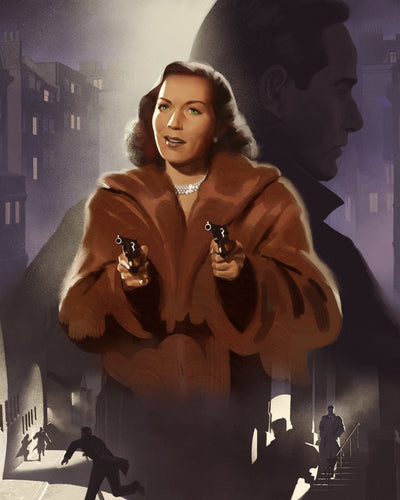
When we catch up with Katie she’s acquired all the trappings of a femme fatale – the low-lit, chichi rooms, fur coat and rocks, and most tellingly, she’s knocking about with a killer who claims she’s double-crossed him. But at this point we can’t be sure she’s all she appears to be, which gives the narrative one of its most effective central mysteries.
Although the film focuses on Bill and his attempts to escape the nightmare he’s been plunged into, Katie casts a long shadow across the adventure as her husband tries to figure out who he was really married to.
In the closing minutes it feels like Bill gets his answer, but the audience might be left feeling undecided as to whether Katie was, after all, ‘a saint or a sinner’. Whip smart, glamorous, witty and brave, Katie Rogers was certainly one of Hammer’s most intriguing noir characters. But was she a wronged wife trying to get out of a hole, or a femme fatale looking to exploit her crooked contacts? We’ll leave that for you to decide…
You’ll find 36 Hours in the Limited Collector's Edition range, alongside Spaceways and other Brit noirs including Blood Orange (1953) and Stolen Face (1952). The latter stars the great Lizabeth Scott, typecast as a femme fatale (and one of the best in the business!) since starring opposite Humphrey Bogart in Dead Reckoning (1947). Here she’s allowed to depart from that kind of role, but still delivers a brilliant, at times chilling performance as Lily Conover. Well worth checking out if you like your villains to possess – like all the best femmes fatales - glamour, guile and infinite style.