

- Article
Coming Soon: Spaceways
In our latest conversation with Steve Rogers we’re focussing on Spaceways (1954), the latest film to be painstakingly restored in 4K, and soon to be available as part of the Limited Collector’s Edition range. But for contextualisation, we’ll also be touching on Hammer in the 50s and the surprising factors that shaped its output. Plus, the travails of the British movie industry during that era, and much more! So what are we waiting for? Sit back and buckle up…
‘Activate take-off boost!’
Stand-by for launch…
‘One to five jets: Active! All take-off jets in action!’
Five, four, three, two, one…
‘Take-off, as scheduled!’
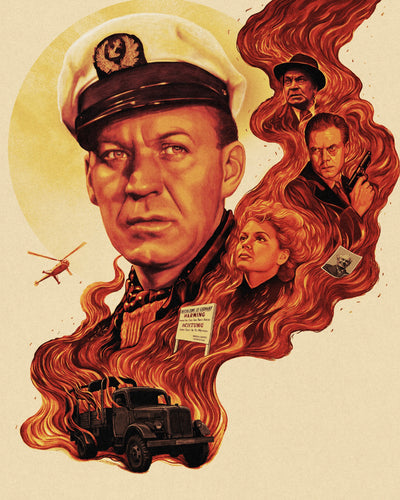
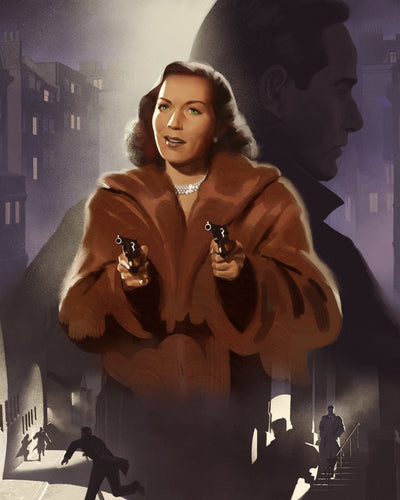
And there she goes! Terence Fisher’s Spaceways is launched and will soon be in orbit in Hammer’s Limited Collector’s Edition range. This ambitious and surprising sci-fi thriller is a tale of rocket launches, doomed romance, espionage, murder mystery and self-sacrifice. Originally premiering less than three years before the launch of Sputnik-1, the first artificial Earth satellite, fired into the ionosphere by the Soviet Union in 1957, this movie captures a specific moment in history when space travel seemed dangerous, romantic, thrilling and imminent.
Spaceways will be available to enjoy in a stunning new 4K restoration, and as with all titles in the range, comes with a raft of bespoke new material that celebrates and explores the film, its background and its makers.
We hurried over to Hammer Command and as always, got the inside track from one of the people responsible for the release, Steve Rogers.

Eva Bartok, seen here in Spaceways, later returned to Hammer to star in Break in the Circle (1955), directed by Val Guest.
Hammer News: This is a hugely enjoyable film, so I suppose that in itself justifies its inclusion in the Limited Collector’s Edition range. But why did the Hammer team decide to restore and release Spaceways at this point?
Steve Rogers: So far we’ve restored and released gothics, science-horrors, crimers and Brits Noirs – but we’ve yet to release Sci-Fi Noir (or Space Noir, if you prefer) so we added it to the mix. In addition, it’s a lovely little thriller, with superb cinematography and direction by some guy called Terence Fisher. I suppose you could turn your original question on its head and ask "why haven’t you released it already?".
HN: Ha! True! For anyone new to the title, could you give us a brief overview of the story it tells?
SR: The chief engineer of the British Space Programme is accused of murdering his wife and her lover and bundling their bodies into an experimental unmanned rocket that now orbits the earth. The only way this poor unfortunate can prove his innocence is to crew the next rocket and dock with the orbiting capsule.

What is it with Hammer and 50s detectives called Smith? Alan Wheatley plays the investigating Dr Smith in Spaceways.
HN: Before we go into the picture’s background, can we linger on its narrative set-up for a moment? One critic expressed disappointment at the ‘murder mystery in a science fiction setting’, but I LOVE the whole whodunnit strand. Could you reflect upon why it works so well, and how Alan Wheatley steals the film, despite only turning up at the halfway point?
SR: If it weren’t for the space element the film would just riff on the same "man unjustly accused and proves his innocence" theme as most of the other Hammer/Lippert productions of the era. But it’s that very space element that makes this particular Hammer film so distinctive. Anyone expecting Flash Gordon, however, was always going to leave the cinema disappointed.
And, yes, Alan Wheatley steals the film – but he does that in every film he’s in. He’s a Cushing-level actor who could have been a lead (and was, on radio) but happily settled into character acting on film. Usually specialising in cads – he’s known to posterity as the definitive Sheriff of Nottingham – he plays against type here to great effect. He only made four films for Hammer and all four are superb performances in superb films.

Cecile Chevreau and Andrew Osborn play Vanessa Mitchell and the dastardly Dr Crenshaw.
HN: Aside from Wheatley, for me, it’s the women who shine in this movie. Would you agree? I mean, Cecile Chevreau is glorious as the wonderfully poisonous Mrs Vanessa Mitchell, isn’t she?
SR: Chevreau takes this part and shakes it by the scruff of its neck – withering disapproval and arch bitchiness are her stock in trade and her thoroughly unpleasant character certainly gets its just desserts.
HN: And Eva Bartok delivers a character who’s in many ways the polar opposite of Vanessa. It’s a terrific performance. What does Eva bring to the movie?
SR: On paper, Eva appears to have been given a thankless character to portray – a female career scientist who unrequitedly falls for the manly hero. But Eva’s performance gives her character an agency that’s probably not there in the original script – Dr Lisa Frank is not a cipher and Eva manages to pull off the magic trick of showing that Lisa is both a scientist and a woman at the same time. Bear in mind, this was the early 1950s – the expectation was that you could be either of those, but not both. You could even make the argument that Dr Lisa Frank as-portrayed was an influence on the Gay Ellis character in Gerry Anderson’s UFO.

Eva Bartok (born Éva Márta Szőke Ivanovics) plays Dr Lisa Frank.
HN: She enjoyed a roller-coaster of a career, but today it seems she’s unfairly overlooked. Could you tell us what she’d been up to before Spaceways?
SR: Prior to Spaceways, Eva’s early life in Hungary was mainly one of survival. Nazi occupation was followed by Soviet occupation – and she eventually managed to get out via a "passport marriage" with sometime-Hammer co-producer Alexander Paal. She then began to carve out her own career in film – most notably, prior to Spaceways, in Burt Lancaster’s The Crimson Pirate – but subsequently became more well-known for her tabloid-fodder love life than her work.
HN: The last half-hour is an absolute whirlwind of action. We’ve got the end game for Vanessa’s story, which plays out brilliantly, we’ve got the detective’s uncovering of what’s really going on and his mad dash back to Deanfield, plus all the drama of the inaugural manned rocket mission. Terence Fisher at his best?
SR: He’s definitely getting there. The last half-hour sees several separate plot strands all dramatically converging to a singularity where Fisher really does dial up the suspense. At 72 years’ remove we lack the proper context to see these films as an audience would originally react to them in the cinema – but I’m sure back then there was a lot of spilled Kia Ora and squished choc ices as the tension gripped the audience in Spaceways’ final act.

Director Terence Fisher, whom The Horror Times hailed as the ‘King of Hammer Films’.
HN: Back in the day, some critics seemed taken aback by the mixture of genres the picture delivers. But viewed today, the mash-up of political skullduggery, shady ‘romantic’ shenanigans, a suave, forceful detective plus, of course, a huge, history-making project fraught with danger, all contrive to make it feel startlingly modern. Would you say it’s a movie that was way ahead of its time?
SR: You can make that argument with anything that doesn’t fit neatly into the zeitgeist of the time, but there is some truth to it here. Space, crime, duplicitous characters, high-stakes tension – this describes Spaceways but it could just as easily describe Outland or The Expanse.
HN: Do you mind if we drill into the film’s background, now? I suppose it’s worth bearing in mind that when it was released, the Cold War was less than a decade old, but was beginning to look like a long-term status quo. The Space Race was about to ignite, and in fact, just a few months after Spaceways hit British cinemas, both the US and USSR declared their intention to launch the world’s first manmade satellites. In other words, the science and political intrigue on show in the picture would have been highly topical. How does Spaceways reflect the public’s interest and fears about what was happening in this emerging world?
SR: The Cold War is firmly at the heart of this narrative but its gloss of science fiction enables Spaceways to work as both a political crime drama and a science murder mystery at the same time. People (usually) went to the cinema to escape the topical news content, but Spaceways’ twist on what they were reading in their newspapers added a layer of unreality that allowed viewers to see the parallels while still being entertained.

Marketing material for Spaceways, which was based on a radio play written by Charles Eric Maine.
HN: Was it Hammer’s first foray into sci-fi? And how did the production come about?
SR: Certainly seems to be. Some reviewers have argued that it’s not science fiction as the majority of the science on display was factually accurate – but it took another eight years before Gagarin orbited the earth in Vostok 1 so, at the time it was made, it was very definitely sci-fi even though they’re not wearing bacofoil mini-skirts or crimplene flares.
It came about because Exclusive had made a lot of money distributing Robert Lippert’s sci-fi drama Rocketship X-M and fancied doing their own version. Spaceways even includes some effects from Rocketship, but the whole thing was done on much less money and in a very British way. Even though they have connective tissue it’s challenging to directly relate Spaceways to Rocketship X-M in any meaningful way. British and American sci-fi are different beasts.
HN: The last act is the most similar to what would follow in The Quatermass Xperiment, but we get parallels (pre-parallels?) to that film throughout. The space mission going disastrously wrong, affairs between members of the ground crew, and so on. How do you think the success of Spaceways influenced Hammer’s decision to go big with sci-fi, most notably with the first Quatermass movie?
SR: Maybe, possibly. Spaceways was filmed between November 1952 and the following January and The Quatermass Experiment was transmitted by BBCtv six months later from July. So it may be the case that, having recently finished post-production on a sci-fi drama, Tony Hinds checked out the new Saturday night series on BBCtv, liked what he saw and reached for his typewriter to option it. We’ll never know – and it’s as likely as it is unlikely – but it’s not impossible that there was some sort of butterfly effect going on.

Certain visuals from Spaceways, such as this striking shot, are echoed in later Hammer works, most obviously their first two Quatermass movies.
HN: The budget was obviously minuscule compared to many recent sci-fi epics, but the Eady Fund boosted the cash that Hammer had in its production funds. What was that, and how did it impact on the studio?
SR: Eady money was part of a Government plan to reinvest in the British film industry by taxing a percentage of each cinema ticket and using those funds to subsidise qualifying British film companies, of which Hammer was one. These funds are what drove American companies to invest in British subsidiaries and paved the way for the many Hammer co-productions of the 1950s and ’60s.
HN: Okay, kind of separately to that, I can’t get my head around where Hammer was at this point. On one hand they were becoming more ambitious and their productions gained bigger budgets. But it’s often cited that two years after Spaceways was produced, The Quatermass Xperiment (1955) saved Hammer. What’s the reality behind this period?
SR: Both things are true. In 1953 – and even 1954 – Hammer were buoyant, with their ongoing Lippert co-production deal that guaranteed them an American star, co-funding and US distribution. But that deal was starting to wind down and the big threat to any British film production company’s survival in 1955 was the advent of ITV, which began transmitting in London in the September. A lot of film companies got scared that year and Hammer was no exception, which is why – while they waited to see how successful The Quatermass Xperiment would be – they had transitioned to making musical shorts. If Xperiment hadn’t been successful, Hammer would have stopped producing and just turned into a services company that leased out Bray Studios and distributed other people’s films.

Smith (foreground) investigates a potential double murder, but is he missing a clue on the poster to his right?
HN: Ah, I hadn’t connected the launch of ITV with what was happening at Hammer and elsewhere in the UK film industry. And it’s incredible to think how close things came to turning out very differently. Thanks for all this background info! Circling back to the release, what additional material will support the restored version of Spaceways?
SR: Two fun new commentaries alongside new programmes on US and UK sci-fi of the 1950s, Howard Duff, Eva Bartok and Alan Wheatley – plus the usual fun-packed booklet of new articles. Basically everything fans and collectors have come to expect and love from a Hammer release of a Hammer film.
HN: Great stuff! Just one final question… When you first re-watched it in preparation for its release, what were your takeaway feelings about the film?
SR: That Alan Wheatley should have made more films for Hammer, that it still stands up seven decades later as a murder-mystery-with-a-twist and that, for anyone seeing this film for the first time, they’re in for a great watch.
Many thanks to Steve Rogers for all his time and insight. You can pre-order Spaceways and browse titles that are available right now by visiting Hammer’s online shop.