

- Article
There’s always something more to discover with Hammer (part one)
After over 90 years of delivering entertainment that embraces films, books, artwork, TV shows, music and much more, we like to think that most fans know there’s something for everyone within the House of Hammer. But we’ll go one step further and suggest there’s always more to discover, more to fascinate and more to enjoy.
As we approach the second anniversary of the award-winning Limited Collector's Edition range, we’re celebrating its richness and the fabulous, unexpected gems waiting to be discovered within it and across all our other new lines. Think you know Hammer? We’re challenging you to think again!
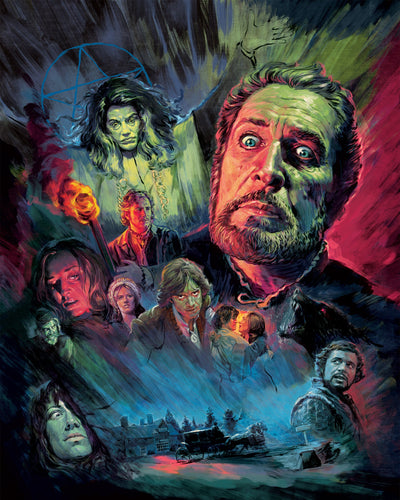
When the Limited Collector's Edition range launched with Captain Kronos: Vampire Hunter (1974), the critic for The Ghost of 82 wrote, ‘… there is something genuinely heartwarming about a film like Kronos being released on 4K… Like the very best releases, all the extras serve the film and enhance one’s opinion of it… it looks gorgeous on 4K, just beautifully restored… I had a lot more fun with it than I was expecting, as I never really rated the film as anything special when I first saw it on a TV showing in the early eighties.’

Caroline Munro relaxes during a location shoot on the production of Captain Kronos: Vampire Hunter.
We’re genuinely thrilled to see people coming to Hammer anew, finding unexpected films to delight in, and enjoying the additional features we love to include with all our releases. There are no facets of our legacy we ignore; we’ve always insisted on saluting the entirety of our output. The Gothics, of course, but also the later horrors, sci-fi adventures and the spectacular (and only ever so slightly OTT!) action movies like Shatter (1974).
It’s such a broad spread that in this feature we’re going to map out some of the ways into and through the collection. Think of it as your guide through the Hammer archives!
And because since 2010 thriller fans across the globe have celebrated Noirvember, it seems fitting we should start by taking a walk down that mean street signposted…
Hammer noir…
‘Hammer noir’ encapsulates the studio’s take on the broader noir genre. The films that fall into this category teem with the tropes you’d expect such as femmes fatales, moody lighting, a certain cynicism coursing through the narrative and, of course, a hard boiled investigator at the heart of the story. But with Hammer noir, there’s something extra which sets it apart.
Take Spaceways (1953), for example. It’s a fabulous little thriller that utilises many items in noir’s toolbox. The doomed romance, ruthless femme fatale and slightly jaded (at times contemptuous) world view are all there, but the detective driving the plot is not exactly your Humphrey Bogart type. As played by the effortlessly suave Alan Wheatley, Dr Smith is cynical, sure, but he’s also determined to see justice done despite the overwhelming odds he’s up against. Shrewd and solitary, he’s also fallible and comes across as curiously academic. So there’s something almost jarring when we see him following up leads on the doorsteps of grim, grey tower blocks. Nevertheless, he’s more Morse than Marlowe yet shows a blistering, quiet rage as his case reaches its shocking conclusion.... Mysterious but relatable, he’s a great example of a Hammer detective transforming a noir into something more satisfying and unexpected.

The fabulous Alan Wheatley, seen here with Eva Bartok, played one of Hammer’s many ‘doctor detectives’ in Spaceways, the movie that Monthly Film Bulletin called, ‘The first British science-fiction picture’.
Lady in the Fog (1952) and Whispering Smith Hits London (1951) also showcase atypical tecs. The latter features a fish-out-of-water sleuth who seems to be having far too much fun for a noir, whilst Cesar Romero injects a similar sense of relish into his portrayal of a writer turned crime fighter in the Lady in the Fog. And both movies have more humour than classic noirs typified by say, Sunset Boulevard (1950) or In a Lonely Place (1950). They never veer close to out-and-out comedy, but there are lols aplenty with the legendary Dora Bryant in Whispering Smith, for example, and Romero squeezes every ounce of humour from his wryer dialogue. Humorous highlight? When his character encounters a witness played by Katie Johnson (best known for portraying Mrs Wilberforce in 1955’s The Ladykillers) we’ve absolutely struck comic gold!
But Hammer also could do traditional noir better than most. Blood Orange (1953), starring the former Falcon, Tom Conway, emerges as one of the finest entries in the genre and deserves to be much better known. A satisfying murder mystery packed with intrigue, glamour and just the right amount of fisticuffs, the lead is on top form as the (admittedly confusingly named) investigator, Tom Conway.
He’s charming, debonair and spry – when could Conway be anything else? – although Blood Orange finds him with a dash of world weariness to suggest a figure who’s been there and got the bruises countless times in previous cases. It’s easy (and fun!) to regard his character as an older version of his most famous role - Tom Lawrence, aka the Falcon. He’s still charismatic and smarter than most of the cops and criminals he’s bumping along with, but this 1950s reality is harsher than its pre-war counterpart. The thugs punch a little harder, the bad guys aren’t quite so obvious, and the ladies no longer swoon at the sight of him raising a roguish eyebrow. This Falcon has yet to have his wings clipped, but they’re fraying at the edges which lends him an appealing vulnerability.

The sublime Tom Conway (centre) with Mila Parély and Richard Wattis, who later played ‘Foxy’ in Hammer’s The Abominable Snowman.
He’s the perfect, slightly battered hero for this sharp, intelligent thriller, but other tough Hammer noirs are available. 36 Hours (1953) is a cracking race-against-the-clock crimer starring Dan Duryea as a US Air Force pilot trying to track down his missing wife in England, whilst Mantrap (1953) sees Paul Henreid, most famous for his roles in Casablanca (1942) and Now, Voyager (1942), playing private eye Hugo Bishop, out to checkmate a bunch of frauds and murderers, all against the arresting backdrop of early 1950s blitz-scarred London.
Henreid turns up again in another noir, the sporadically brutal but engrossing Stolen Face (1952), which brings us to…

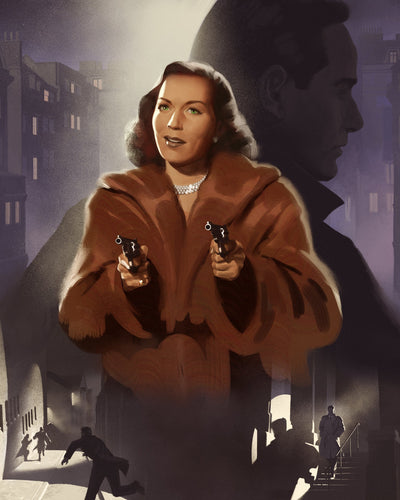
Marketing material for Stolen Face, featuring Lizabeth Scott and Paul Henreid.
More than a monster…
It’s fair to say Hammer has given audiences more than their fair share of monsters that were… well, monstrous. From the relentless predators attacking Raquel Welch in One Million Years B.C. (1966) and the undead killers in The Plague of the Zombies (1966), to more human looking horrors like Dracula and the frankly terrifying Mrs. Trefoile in Fanatic (1965), the studio has enriched cinema with cruel and memorable monsters who could grace any nightmare.
But it’s also shown us monsters we can sympathise with and maybe even applaud. In the Hammer noir, Stolen Face, Lily Conover is often presented as the villain of the piece, but watching the film today it’s hard not to identify with the ex-con, bearing in mind the hell she’s been put through by pretty much everyone she’s ever clinked glasses with. When the heartbroken Doctor Ritter (Henreid) tries to mould her into his lost love, can we blame her for rejecting the role of ‘dutiful little woman’ or reverting to type when her new partner shows a staggering lack of empathy?
Similarly, the Carroon ‘creature’ in The Quatermass Xperiment (1955) may look like a monster, and let’s not forget he’s a killer who presents a clear and present danger to the whole of humanity, but the audience can’t fail to have pity for the man at its core. Victor Carroon never asked for the transformation he’s forced to endure and, courtesy of Richard Wordsworth’s nuanced performance, we witness the anguish it causes him in his eyes, his expressions and smallest movements.
It’s fitting that when Bernard and his colleagues watch the entity’s destruction there’s no triumph or satisfaction on their faces. The death is observed in a stunned, sorrowful silence. They recognise the ambiguity of the threat they faced and later, when a copper called Lomax tells the Professor he’s won and starts blathering on about praying, Bernard simply turns and walks away.

‘A timeless terror to freeze you to your seats!’ As straplines go, it certainly delivered an original promise.
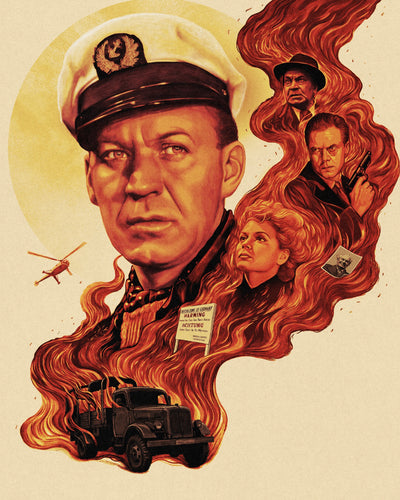
But the Yeti in The Abominable Snowman (1957) remains the prime example of ‘more than a monster’. Audience members flocking to see the picture had been primed to expect the legendary creatures would be the adventure’s sole source of horror with posters depicting the hand of the ‘beast’ reaching menacingly towards a defenceless woman, or its enormous shadow falling threateningly across terrified human targets.
Hysterical shout lines rammed home the point with an almost fervid glee: ‘Demon-prowler of mountain shadows… Dreaded man-beast of Tibet… Terror of all that is human!’
It’s established fairly swiftly, however, that the real menace on these mountaintops is the group of British and American chancers who are visiting South Asia and planning to take home more than a fridge full of snow samples. One of them, John Rollason, seems like a civilised and reasonable scientist, but the wise old lama has got him pegged and immediately voices suspicions regarding his reasons for exploring the Himalayas with the brasher Tom Friend. The sage makes it clear where the real danger lies: ‘As you seek this creature, remember that you act in the name of mankind and act humbly, for man is near to forfeiting his right to lead the world,’ he warns him, before adding the crucial statement: ‘He faces destruction by his own hand.’
It’s not long before Rollason begins to regret his collaboration. ‘You're nothing but a cheap fairground trickster!’ he tells Friend, but in truth this abominable showman represents something infinitely more dangerous. They’re stuck on the planet’s highest mountain yet there are no depths to which Friend won’t sink in order to capture his prize. And when members of the expedition begin dying one-by-one, the American is keen to denigrate the ‘snowmen’ and place the blame on their actions, branding the species, ‘animals… dangerous killers - and that’s all they are!
Rollason remains clearer headed, ‘This isn’t the face of a savage thing…’ he says of one of the creatures, noting, ‘There’s gentleness [in its form].’
Later, he puts the matter even more plainly: ‘It isn’t what’s out there that’s dangerous… it’s what in us.’

The Abominable Snowman starred Peter Cushing and Forrest Tucker. The latter had previously played Captain Morgan in another Hammer directed by Val Guest, Break in the Circle (1955).
The Yeti, meanwhile, emerge with a kind of inherent majesty and wisdom that feels as old as the hills they inhabit. Friend has invaded their territory in the role of a hunter and ironically declares they’re out to ‘get us all’, but these so-called demon-prowlers seek patience and peace. Nothing more. There’s only one monster in The Abominable Snowman, and it comes with greed and guns.
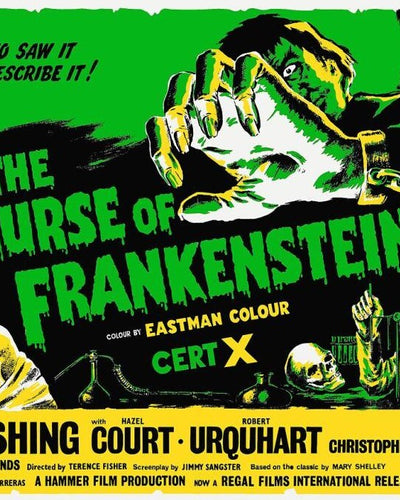
We’ve covered the film in more detail, but it’s just one of many works which shows that any collection of Hammer titles is more than a collection of films. The Limited Edition Collector’s range builds into a family of themes and ideas, genres that interlink and intertwine, concepts that are echoed and built upon in differing, dizzying ways. And so the noirish Stolen Face finds a resonance in The Abominable Snowman as surely as The Curse of Frankenstein (1957) foreshadows the Gothic masterpieces that followed. These and other familiar classics nestle amongst gems awaiting rediscovery. This is more than an archive, it’s a treasure chest of cinema almost a century in the making.
So, with such a huge and exciting cache of movies to choose from, what’s the best way to plunge into the Hammer archive? Obviously, there are dozens of potential entry points, but we’d recommend starting with a stone cold classic and beginning your journey just outside Klausenburg…

‘…the new 4K restoration does something rather remarkable: it doesn’t simply make the film look better. It allows you to see the film anew.’ – Terry Sherwood (Grimmfest 2026) on Hammer’s recent restoration of Dracula.
Start with a classic… I am Dracula!
Admit it. You thought we’d suggest starting with a lesser known title. Four Sided Triangle (1953), perhaps? Director Terence Fisher’s first stab at a Frankenstein-esque thriller certainly entered our thoughts, as did the studio’s earliest Gothic sensation, The Curse of Frankenstein. But to get the party started you can always count on the Count, so we’re suggesting your portal into the House of Hammer is the 1958 classic that cemented the studio’s position as cinema’s primary purveyors of horror: Dracula.
Author and critic Ryan Harvey commented, ‘This is a rare example of a perfect film…’ and we can’t disagree. ‘It compresses the novel to a lean, explosive story that’s so vibrant it threatens to burn off the screen,’ Harvey continued, ‘It’s sexy, surprising, and paced like Dracula’s careening coach. The finale is one of the most exciting horror climaxes ever crafted, and the film was already firing on all cylinders before then.’ Yep. We still can’t disagree.
There’s a reason this film is regularly cited as one of the top British movies ever made, and instead of discussing why that is, we’ve simply made it available to watch in a myriad different ways so you can have the pleasure of either finding out, or reminding yourself of its enduring quality.
Like the Hammer archive itself, Dracula remains simultaneously old and new. Ancient, in terms of its mythical roots. The powerful undead seeking to unleash an almost unimaginable evil, with the forces of good, valiantly attempting to protect the innocent and vanquish the malignant force. But it feels fresh, both in terms of its narrative pace and the evergreen themes it chooses to explore.
Fans wanting the full on experience can grab the Dracula Limited Collector's Edition which bares its fangs with a mouthwatering 7 discs, including 5 iterations of the movie and well over a dozen featurettes examining all aspects of this landmark production. Want something lighter on the additional content? No problem! You can still enjoy the film, restored in glorious 4K with plenty of accompanying featurettes, but at a lower price point by checking out this release.
And the best thing?

A world of Dracula is at your door…
After enjoying Dracula we’ve made sure you can continue your Hammer odyssey in any number of ways. Dive deeper into the film with releases like the Dracula Scriptbook, or if you loved a specific aspect of the work - maybe its score by James Bernard - the Dracula Limited Edition LP is for you.
If you’re intrigued by other Hammer horrors, we’ve got everything from 50s classics including The Man Who Could Cheat Death (1959) and X the Unknown (1956), to more recent works such as Doctor Jekyll (2023) starring Eddie Izzard, Lindsay Duncan and Simon Callow.
An array of genres, a wealth of formats and hopefully, as we said at the start, something for everybody. And however you choose to build your Hammer collection, we can guarantee a rich and evolving world of ranges to develop it.
Not just with the kind of releases discussed above, but in ways which would have been considered impossible until very recently.
But that’s a story for next time…
Find all the films mentioned above, and much, much more, at the Hammer online store.