

- Article
Hammer Star Lois Maxwell: Before Her Majesty’s Secret Service.
She was fearless and fun, award-winningly talented and capricious, yet resolutely practical. Lois Maxwell will always be remembered as the steadfast Miss Moneypenny throughout the first 14 Eon-produced James Bond movies, debuting as M’s secretary in Dr. No (1962) and only retiring from the role when Roger Moore handed in his double-0 licence after A View to a Kill (1985). But there’s so much more to her life and career than the Bond franchise.
Hammer films, horror, opera, iconic TV shows and the first British movie to receive an X certificate all feature on her impressive CV, and away from the cameras she led an extraordinary life characterised by early, remarkable risk-taking before Moneypenny threatened to monopolise her legacy forever. And so, in the hope of redressing that slightly, here is the unexpected story of Lois Maxwell, before Her Majesty’s Secret Service.
There’s a certain irony in the date of Lois Maxwell’s birthday. For a woman who would become so firmly associated with a character that forever missed out on romance, it feels inappropriate, but she came into the world in 1927 on St. Valentine’s Day. Born Lois Ruth Hooker in Kitchener, Ontario, her father, William, was a teacher whilst her mother, Ruth, worked as a nurse – a role she would play in multiple productions during her early career. Incidentally, Lois clearly recognised the conations of her birth name and with typical wry humour, in her post-Bond days she announced that her memoirs (sadly never finished) would be titled, Born a Hooker.
Her first foray into showbusiness was a covert operation. Her parents were far from enamoured with her early vocation and as a youngster she would secretly sneak off to take part in a children’s radio programme, produced locally, insisting she was billed as ‘Robin Wells’ to avoid her mum and dad discovering her involvement. It was the beginning of a career that would endure for well over half a century.

‘Lois Maxwell didn't have enough tributes in her life… She was my lucky token and those that remember the Bond films with Moneypenny will remember her with great affection.’ – Roger Moore, discussing his friend, Lois Maxwell.
Another early job saw her working as a waitress at the Bigwin Inn, a bougie, exclusive summer resort on Bigwin Island in the Lake of Bays, Ontario. A sprawling playground for the rich and famous, it wouldn’t have looked out of place in a Bond movie and attracted celebrities ranging from the Rockefellers, Hemingway and H.G. Welles to European royal families. But Hollywood royalty also stayed on its shores, and acting icons such as Humphrey Bogart, Fred Astaire, Carole Lombard and Clarke Gable were known to enjoy the island’s charms. It’s almost impossible to envisage teenager Lois Hooker in this A-lister environment and not fall for the charisma, star quality and ‘shine’ which these and similar luminaries gave to her place of work.
It was perhaps part of the reason that even as World War II raged, and not yet 16 years old, she ran away from home and joined the Canadian Women's Army Corps. Officially established in August 1941, the unit was formed as a response to public pressure from women demanding to serve. Designed for non-combatant duties like secretarial chores, delivery work, chauffeuring, cooking and equipment maintenance, it was deemed a huge success and ultimately over 20,000 women enlisted in the CWAC during its first four years.
Around this time, Canada’s Department of National Defense helped create The Canadian Army Radio Show, (widely known as The Army Show) a ‘soldier-centric’ entertainment programme so popular it triggered the creation of a touring stage version intended to cheer up troops, boost general morale, promote recruitment into the forces and bolster the sale of war bonds. In other words, it was a Canadian version of the much more famous ENSA and America’s USO. Crucially, this production troupe was split into 5 units and sent to the UK where, commanded by Major Rai Purdy, they became known collectively as the Canadian Auxiliary Services Entertainment Unit.
Lois – still lying about her age – managed to switch roles, initially inveigling her way into The Army Show in which she danced and sang for troops in Canada. When the organisation upped sticks to Britain she had a choice to make. Go back to the safety of her familial home, or continue to misrepresent her age, take a chance and travel the globe as part of an entertainment unit. Despite the dangers inherent in the second option, it was the one she seized and the young performer suddenly found herself over 3,500 miles away from everything she’d ever known.
So far, so fortunate. But Lois Hooker’s luck was about to run out…

Maxwell was a pragmatic thinker and once told interviewer Graham Rye, ‘What people tend to forget, even people in our business, is that the film industry is a business – they’re not there for charity!’
It’s worth pausing at this point. It’s easy to trace a sequence of events and outline the facts that retrospectively helped create what today we’d term an ‘origin story’. But it’s useful to recognise the feelings and ambitions that determined those facts. The drive and audacity that made Lois, as a child, steal away from her house to secretly work on a local radio show. The guts and single-mindedness that somehow allowed her to con her way into the CWAC and soon after, The Army Show.
And, of course, it’s informative to imagine the fear and excitement Lois must have felt as she left Canada, flying from the safety of North America into the unknown furnace of war-torn Europe. The world was on fire, but she wanted to be a part of it. She’d mingled with the silver screen elite back in Bigwin, and now she was hurtling into their fold, determined to make it to the top despite every obstacle and danger that stood in her way.
One of those dangers was the very real possibility that someone would discover her true age, and after working with the Canadian Auxiliary Services Entertainment Unit and being part of the outfit during its fledgling days in Britain, that’s precisely what happened. It was seriously bad news for Lois, who’d technically been exposed as a liar, and it wasn’t a good look for the unit who could be deemed at fault for having a child in their ranks.
The upshot of the ‘unmasking’ remains uncertain. Some reports claim Lois was treated roughly – arrested and given a custodial sentence in Southern England. Other accounts suggest that a ‘deal’ was hastily reached whereby Lois was discharged from her unit and legally allowed to avoid repatriation. Whatever the exact details of the matter, this setback evidently didn’t deter Lois and instead of returning to Ontario she won a scholarship for the prestigious drama school, RADA, based on Gower Street in London’s fashionable Bloomsbury. Even here she was far from safe - the academy’s main hub was partly destroyed by enemy bombs, but it would take more than the blitz to stop the resolute young Canadian…
Her leap from ‘song and dance girl’ to student of acting at the Royal Academy may not have been planned, but the sudden shift represented another significant move forward as she homed in on the profession she would eventually thrive within.
After graduating from RADA she elected to remain in London, working in radio and earning money as a model. But the lure of the silver screen was already tugging at her, and she made her movie debut in Powell & Pressburger’s A Matter of Life and Death (1946). It was a small part and uncredited, but as introductions go, appearing in one of cinema’s greatest works isn’t a bad start. Another uncredited role followed in Spring Song (1946), a British musical drama film directed by Montgomery Tully starring Peter Graves and, amongst others, Alan Wheatley. Picture Show called it, ‘Agreeable entertainment.’ and Variety opined, ‘… it gives real entertainment value…’

Lois Maxwell (left) with Shirley Temple in That Hagen Girl. It proved to be the former’s breakout movie, despite the controversy that surrounded it, with Bosley Crowther of the New York Times branding it, ‘Thoroughly un-American.’
Neither film showcased Lois in any meaningful sense, but whilst performing on the London stage her skills were noted by a Hollywood talent spotter. It proved to be another important break and in a blur of what must have felt like a giddy sequence of events, it immediately led to a contract with Warner Bros and she was duly catapulted from bit parts in Britain to a meaty role in Tinsel Town. Whisked across to LA to star in a Shirley Temple/Ronald Reagan vehicle called That Hagen Girl (1947), it was her first involvement in a movie where she played a significant character. However, the phrase ‘baptism of fire’ comes readily to mind…
In Child Star: An Autobiography, Shirley Temple (by that point Temple Black) recalled that her and Lois’s co-star, Ronald Reagan, hated his part and was enduring a tough time away from the cameras. Health-wise he wasn’t in the best place and after one particularly gruelling set of retakes he collapsed and wound up in Cedars of Lebanon Hospital, diagnosed with viral pneumonia. The future President felt this was the least likable character he’d ever played and critics tended to agree, giving the drama short shrift when it opened in November, 1947.
But somehow Lois Maxwell (as she was now officially known after ‘borrowing’ her new surname from a ballet dancer friend) succeeded in rising above the production’s problems to deliver a potent and memorable performance.
Watching That Hagen Girl now, it’s hard to believe Maxell was in her (very) early 20s during the movie’s production. She seems older, not just in her looks, but in her bearing. Her character, Julia Kane, is supposed to be a seasoned woman of the world – a maternal figure to the titular tearaway, and she delivers on this, playing her character as if she’s handing out lessons she herself has learnt through bruising experience. Maxwell treads carefully in moments which could have been overplayed, such as when her character declares she’s leaving the man she clearly holds an affection for, and there’s a very slight primness to her delivery, even when she sides with Temple’s rebellious lead. This latter point is a small detail, but one which adds authenticity to her performance.

In his autobiography, Ronald Reagan recalled trying to persuade director Peter Godfrey to change the ending of That Hagen Girl. He didn’t succeed, but despite this, and the disparagement of critics, the movie turned out to be a modest hit and formed an effective springboard for Lois Maxwell’s film career.
Critics couldn’t fail to take notice, and the role of Julia Kane won Maxwell the prestigious Golden Globe Award for Most Promising Newcomer. As if to cement this acknowledgment, two years later she was given the accolade of appearing in a Life magazine feature which sought to throw a spotlight on the most talented young actresses of the day – the ‘starlets’ most likely to become stars. The piece included a photoshoot in which Maxwell posed with up-and-coming ‘names’ like Laurette Luez, Enrica Soma and, positioned at the front of the cluster, a little-known, fair-haired ingénue called Marilyn Monroe…
The late 40s also saw Maxwell become a familiar face in a range of productions, appearing in several features including Corridor of Mirrors (1948) a British horror film directed by Terence Young and co-starring Christopher Lee in one of his very early movie appearances. She also enjoyed substantial roles in the noirs, The Big Punch (1948) and The Dark Past (1948), the Western Kazan (1949) and the final entry in Columbia’s Crime Doctor series, The Crime Doctor’s Diary (1949).

Lois Maxwell starred opposite Gordon MacRae and in The Big Punch. Today the latter is best-known for his roles in two of Rodgers and Hammerstein’s most iconic movie musicals, namely Oklahoma! (1955) and Carousel (1956).
Restless and pursuing fresh opportunities, she moved to Rome and starred in a number of Italian productions, even appearing opposite Sophia Loren in a version of Verdi’s opera, Aida (1953), directed by Clemente Fracassi. Whilst in Italy she also became a keen amateur racing driver, living her life in the fast lane both figuratively and literally. Yet although she was based in the Eternal City, she continued to appear in movies shot in the UK and even began starring in a number of BBC dramas.
The Guardian wrote of Maxwell, ‘…during the 1950s [she] became a familiar face in British cinema. With one or two exceptions, however, the films in which she was featured belonged to that category of formulaic B feature crime stories that have now largely disappeared even from the schedules of night-time television.’
This withering assessment feels remarkably reductive and not a little inaccurate. Her Italian filmography alone spanned operas, anti-war drama and comedy, and away from the Continent, her pre-Bond portfolio includes Gothics, sci-fi and romantic thrillers. She guested in iconic TV shows including Danger Man, appearing opposite Patrick McGoohan and Donald Pleasance in the 1960 adventure, Position of Trust. Maxwell also collaborated with filmmakers who tended to only work with the best. Stanley Kubrick directed her in Lolita (1962) for instance, and Joseph Losey was at the helm for Time Without Pity (1957), a Brit noir that also featured Peter Cushing.
Hammer aficionados will recall her two cracking movies for the studio. In Mantrap (1953) she plays Thelma, the former wife of a man who’s been sent down for murder. The trouble escalates when he escapes from prison, leaving her terrified that he’ll take bloody revenge on her for beginning a relationship with a new beau. Thelma (and Lois) are two of the movie’s pivotal strengths and director Terence Fisher clearly trusted his Canadian star. Even before the picture’s quarter-of-an-hour mark she appears entirely on her own in a scene that lasts over 4 minutes.

A behind-the-scenes shot of Lois Maxwell (far right), on location for the production of Hammer’s Mantrap.
It’s a gripping sequence in which Thelma goes from fatigue and mild anxiety to out-and-out terror. She manages to resist the temptation of booze but is immediately forced to conceal her fear, with Maxwell opting to eschew the trembling hand and quivering upper lip approach to convey this; instead, her character’s dread is evinced in a small, everyday mannerisms that become mechanical, and there’s an awful, underplayed tension in her voice as she speaks to a friend on the phone who remains oblivious to her plight.
She later shares a great scene with lead Paul Henreid, and their chemistry highlights the missed opportunity that their characters don’t enjoy more moments together. Again, Maxwell is astute, beginning the scene in command, almost haughty, but gradually dissolving as her nerves and desperation become more apparent. As Hammer’s Steve Rogers stated when the film became part of the Limited Collector's Edition range, ‘Lois gives a highly watchable performance as a woman-on-the-edge in Mantrap...’

Marketing material for Mantrap, describing Maxwell’s character as the ‘Beauty Who Betrayed Him’ which feels a little unfair on the innocent but haunted figure of Thelma.
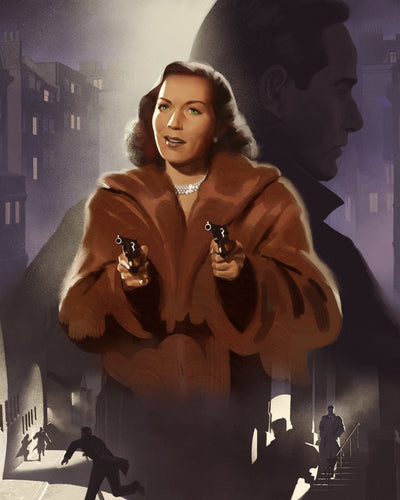
But for anyone who’s only known Maxwell as Moneypenny, Hammer’s Lady in the Fog (1952), is a must-see. Based on the 1947 BBC radio serial, A Lady in the Fog, it emerges from the mist as a curiosity insofar as it’s a British mystery/thriller written and directed by Americans with leads Cesar Romero and Lois Maxwell both hailing from North America.
Reviewing the film, critic Brian Naas called the latter star, ‘a knockout early in her career’ and this movie epitomises the fact. Spoilers ahead: she’s a revelation as the icy femme fatale, Peggy Maybrick, by turns provocative and dismissive, ostensibly vulnerable and utterly, shockingly ruthless. In the later Bond films, Geoffrey Keen played one of Moneypenny’s bosses, the eternally harassed Minister of Defence, ‘Freddie’ Gray. But here, as the apparently confident and gregarious villain, Christopher Hampden, he finds Maxwell’s Maybrick is his superior in every sense. She smoothly takes control when their murderous plans begin to fall apart and demonstrates she’s willing (and perhaps eager) to kill whoever stands between her and their nefarious goals.
It’s a fun, exciting flick which, as The Kinematograph Weekly declared at the time of its release, ‘…puts plenty of action and no little kick into its dizzy surface action.’

Text: Writing for Avengers Forever, Pete Stampede praised Maxwell’s ‘edge of transatlantic sophistication’ that she brought to her output throughout the 1950s.
Other of Maxwell’s films of the period include the first British movie to be given an X certificate, the hard-hitting drama, Women of Twilight (1952). As Tipping My Fedora acknowledged, ‘Maxwell is very good as the ‘nice’ girl Christine’, a character many have argued is written as the audience’s ‘identification figure’. She delivers a nuanced, touching performance and as Film Carnage shrewdly explained, ‘[It’s]… Rene Ray and Lois Maxwell who really serve as the heart of this story… a rare celebration of talented women for its time, not only telling a poignant story of the treatment of women but giving the limelight to an ensemble of fantastic actresses to do so… It’s undoubtedly a classic film that deserves a lot more attention.’
After meeting in Paris, Maxwell married TV executive Peter Marriott in 1957 and the couple moved to London and started a family soon after. But her husband’s ill-health (he suffered a massive heart attack in 1961) left them struggling financially, with Maxwell later characterising her situation as being ‘poor’. Looking back on that period she candidly told the 007 Magazine, ‘I was happy to play it [the role of Moneypenny]’ adding, ‘because as I said, I needed the money.’

This shot from Mantrap shows Lois Maxwell nonchalantly dealing with an armed man wearing a dinner suit. It would be a situation she revisited time and again, later in her career…
In a move that would have far reaching consequences, she’d contacted Terence Young, asking if he could offer her any jobs. In actual fact, he’d famously turned her down previously, claiming she ‘looked like she smelled of soap’. But having worked with her on Corridor of Mirrors he was well aware of her strengths and quickly offered her a choice of roles on Dr. No, hoping she would play either Bond’s first filmic squeeze, Sylvia Trench, or M’s secretary. The latter entailed a mere two days' work at a rate of £100 per day (wardrobe not supplied!) but she opted for the part on the condition that she could imbue her character with a backstory, and move beyond the aesthetics of the stereotypical secretary, hidden behind horn-rimmed glasses and having hair lashed back into a bun. Young readily agreed and Maxwell was handed the role of her career.
It changed her life and the prism through which she would thereafter be perceived. Her first scene as England’s ‘last line of defence’ was shot in Pinewood Studios in February, 1962 and Dr No premiered in October. At that point, to millions round the world, she not only played Moneypenny, she became Moneypenny, a synergy which only strengthened as she reprised the role in over a dozen more Bond outings. It was therefore inevitable that the part impacted on the breadth of roles Maxwell was subsequently offered.
But equally, with global fame and recognition came a sense of achievement and completion. In her first starring role, playing Julia Kane in That Hagen Girl, she delivers a memorable line, telling Temple’s character, ‘I’ve been running away from places and people and things all my life.’
In a sense, that had been Lois Maxwell herself. Sneaking out of her home and scarpering off to the local radio company to break into showbusiness, secretly enlisting in the Canadian Women's Army Corps, haring off to England, storming into the movies, careering around the Continent and… And now she had won a degree of respite by reporting for duty on Her Majesty’s Secret Service… meaning the kid from Kitchener could finally stop running.
The second of Lois Maxwell’s films for Hammer, Mantrap, is available now as part of the Limited Collector's Edition range.