

- Article
Coming Soon in the Limited Collector’s Edition Range: The Man Who Could Cheat Death
Excluding movies featuring Frankenstein or Dracula, it’s arguably Hammer’s most Hammer film: a sumptuous, thrilling horror that invites its audience into a world of twisted romance, murder and scientific madness. As visually alluring as it is macabre, on its release the Kinematograph Weekly called it, ‘A sure bet… fascinating and thrilling’, and over 65 years later critics remain quick to praise its enduring charms. It’s a classic gothic, directed with Terence Fisher’s customary flair, and featuring stalwarts like Christopher Lee and Hazel Court.
And did we mention it’s been restored in 4K from the original film negatives and includes optional, originally-censored scenes thought lost for years? The movie is, of course, The Man Who Could Cheat Death (1959) and we’re delighted to confirm it’s the latest title in Hammer’s Limited Collector's Edition range.
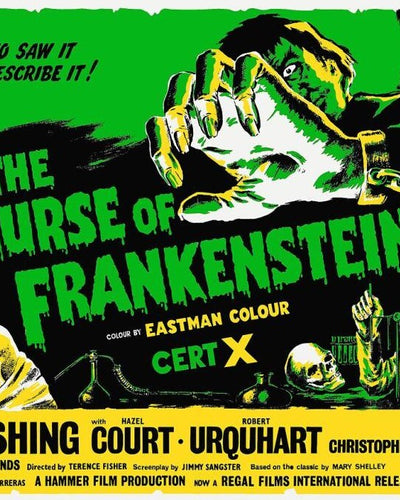
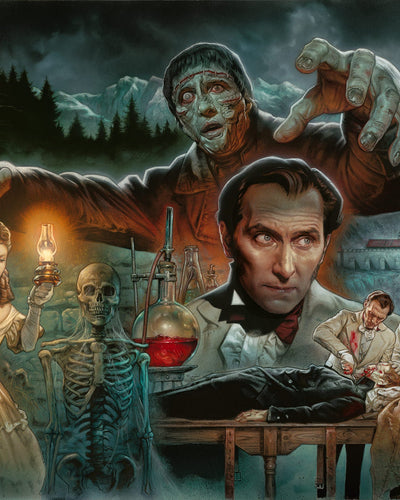
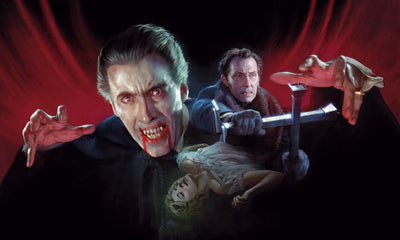
Back in the 1950s Hammer showed it knew a thing or two about taking an enduring, universal myth, sprucing it up and repackaging it as a distinctive horror. Dracula (1958) and The Curse of Frankenstein (1957) are the obvious examples, but The Man Who Could Cheat Death is another instance of the studio embracing and embellishing a premise that has become more than a myth; it has become a warning. A crowd-pleasing parable.

This lobby card features Arnold Marlé (l) and Anton Diffring in one of the film’s most high impact scenes.
The notion of an individual seeking immortality has existed for millennia, and curiously, it’s usually presented as the archetypal Bad Idea. In Ancient Greek mythology, for example, when Eos begged her fellow gods to grant her lover, Tithonus, an unending life, they were happy to oblige, but it turns out there was a catch. Although the human was given immortality, he wasn’t fixed up with the full package that would have made him godlike. Crucially, his gift from Zeus didn’t cover him for aging as such, and he grew manifestly older across the decades and centuries, forever withering, ultimately transforming into a babbling, shrivelled up creature which some versions of the tale suggest gave the world cicadas.
Tithonus’s gruesome fate reflects the traditional end point for most who seek immortality. Put simply, it never works out well.
The man seeking to cheat death in this story is Georges Bonner, a brilliant doctor, sculptor and all round cad about town, that ‘town’ being Paris in the early 1890s. Based at the ominous sounding 13, Rue Noire, he appears to be relatively youthful – somewhere in his 40s? – but it’s soon revealed he’s a little over 100 years old, and as this is a Hammer movie, you can bet the secret to his boyish good looks is more than a pricey moisturizer and a strict Mediterranean diet. Sure enough, it transpires Bonner unlocked the secret of immortality with a collaborator, Professor Ludwig Weiss, decades earlier. The process it entails has always been hazardous and required appalling sacrifices, but when Weiss is late reaching Paris to help out his (very) old friend, it becomes even more dangerous, and not simply for Bonner…

‘Anton [Diffring] was, unlike his image, a nice, charming man.’ – Hazel Court.
Anton Diffring plays the doctor as a cruel and relentless fiend, emerging as one of the most out-and-out evil creations in Hammer’s distinguished roll call of villains. Victor Frankenstein wanted ‘to play god’ and create life, but although he was driven by vanity, his experiments retained a semblance of scientific worth. He genuinely wanted to push back the barriers of human understanding, whereas Bonner is only interested in Bonner. He’s shown to be narcissistic and merciless. A killer who cares solely about his own needs and hunger, and whose scientific genius becomes nothing more than an instrument to further his own desires.
It’s the kind of role Diffring excels in, and he later sneered his way through Circus of Horrors (1960) playing a similar character, before perfecting an air of offhand cruelty for Where Eagles Dare (1968) in which he portrayed the icy Paul ‘Let me remind you, Major, I am a Colonel in the SS!’ Kramer.
The ever-dependable Hazel Court, previously seen as Elizabeth in The Curse of Frankenstein, is back on smitten-with-a-very-dangerous-man duty, here playing Janine Dubois, an innocent young woman who’s drawn perilously close to Bonner. Her ‘escort’, Dr Pierre Gerrard, is played by Christopher Lee, and as The After Movie Diner pointed out, ‘…he’s all gravitas and magnetism’ as the vigilant medic whose suspicions about Bonner may prove costly.

A promotional shot showing (l-r) Christopher Lee, Hazel Court and Anton Diffring.
The Man Who Could Cheat Death was the second big screen version of Barré Lyndon’s hit play, The Man in Half Moon Street, with the first (which retained the source material’s title) being shot by Paramount Pictures in 1945. For Hammer’s version scriptwriter Jimmy Sangster jettisoned much of what made Lyndon’s work so gripping. The heists, the humour and a tense siege at the end of the story are all excluded, and the central character transformed from a morally ambiguous, tragic figure, to a Machiavellian monster to be despised, but never pitied.
Yet Sangster was able to create a thriller that’s arguably more dynamic and pacey. It feels like a close relative of Hammer’s masterpieces, Dracula and The Curse of Frankenstein, but it’s patently different enough to more than retain our interest. This is no pale imitation. Rather, it proves to be a vivid addition that shines in its own unique way. In short, it’s a cracking horror that delivers scares, twists and some memorable performances. The Man in Half Moon Street may stand as a thoughtful play that examines the grim potential of scientific misuse in 1930s Europe, but The Man Who Could Cheat Death emerges as pure entertainment. Confident, gorgeous-looking and unpretentious. As critic Gemma Robson noted for The Oxford Student, ‘…it’s a fun choice for a movie night with friends.’

This striking Belgian poster does a fantastic job in capturing the horror and essence of the film.
Reviewer Matthew Hartman called the film, ‘…briskly-paced… chilling… engaging and damn creepy’. He also termed it an ‘often underappreciated gem’, but it’s to be hoped that its induction into Hammer’s Limited Collector’s Edition range will at least take care of that ‘underappreciated’ problem.
To learn more about the release, we caught up with Hammer’s Steve Rogers and began by asking why he felt this was the right time to return to the Rue Noire…
‘I think it's not too glib an answer to say that any time of year is the right time for a new release of a Hammer Gothic and it's very much a complementary release to Dracula. There's no teeth and blood, but this is one of the first tranches of Hammer Gothics from the late 1950s and basically has the same key line-up as The Curse of Frankenstein, barring Peter Cushing.’
And what can fans look forward to with the latest addition to the award-winning range?
‘The key part of this release is that we are able to make the film available to fans and collectors in six iterations, including viewing it optionally with alternative footage only seen in Europe and fire stunt footage censored by the BBFC in 1959.’

This US promotional material shows Bonner getting to grips with the problem of his partner in crime, the unfortunate Professor Weiss.
Six iterations? Tell us more!
‘Each has their own commentary, and the set also features Hammer expert Wayne Kinsey giving us the story behind the making of this classic Hammer Gothic, some cool featurettes made for Vinegar Syndrome's release last year (we partnered with them when we created this new restoration) and two essential 1999 recordings from the Festival of Fantastic Films' archive: an interview with Hazel Court and a stage panel that features Hazel, Jimmy Sangster and legendary director Freddie Francis.’
Steve shared more about the additional features accompanying the release and it’s clear it’s one of the most comprehensive offerings to date. The array of commentaries includes experts such as Lizbeth Myles and Paul Cornell, Kim Newman and Stephen Jones, Lucy Bolton and Pamela Hutchinson, and Constantine Nasr and Dr Steve Haberman.
The range of featurettes it boasts is equally mouthwatering and includes archive rarities like The Man Who Can Chat Death, an insightful interview with Hugh Harlow, a Hammer mainstay and third AD on this feature, plus Court in Session, in which film historian Melanie Williams discusses Hazel Court, and The Man Who Could Direct Death which looks at the legendary Terence Fisher. There are new featurettes, as well, including one that examines the 4K restoration of this 1959 classic.

Court In Session traces the rise of Hazel Court (seen here on the right with Delphi Lawrence) and examines how and why she was perfect within the horror genre.
As always, the discs are accompanied by a chunky, lavishly illustrated book. This one includes an in-depth look at Barré Lyndon’s play, The Man in Half Moon Street, and how it evolved into the 1945 movie of the same name, which was finally remade as The Man Who Could Cheat Death. It also features a reproduction of make-up man Roy Ashton's annotated copy of the original shooting script, as well a wealth of photographs relating to the movie.
We asked Steve for a final word on the work and this release. ‘Lots of books on Hammer give this film the Black Spot purely because of Cushing’s absence,’ he told us. ‘But it's an excellent gothic horror and this new restoration shows its cinematography, costuming and set design off to stunning effect. It's a great watch.’
To find out more and to pre-order The Man Who Could Cheat Death, visit the online Hammer store.
You can also explore other titles in the Limited Collector’s Edition range and if you’re a fan of Hazel Court, you can enjoy her in the seminal The Curse of Frankenstein, whilst Arnold Marlé enthusiasts can savor his performance in Sidney J. Furie’s chilling The Snake Woman (1961).