

- Article
Coming Soon – Hammer Presents: Daughter of Darkness
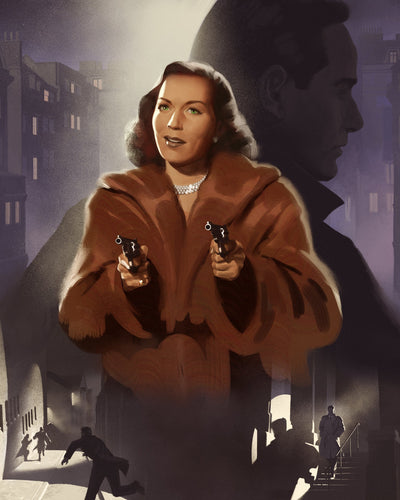
Some films are tailor-made for those long, wintry nights when the evenings start drawing in and going out feels like a bother. When you want a tale of terror that offers more than body horror and jump scares. The kind of quietly engrossing movie that possesses eeriness, audacity, thrills and genuine chills, so that shiver sliding across your shoulders might be caused by the sound of cold winds outside, or it could be caused by the frights unfolding on your screen… Daughter of Darkness (1948) falls into this category so perfectly it could have been produced for it, and we’re delighted to confirm this minor masterpiece is the next title in the acclaimed Hammer Presents range.
Before we begin, it’s worth noting that any significant look at Daughter of Darkness must contain spoilers. Its narrative advances through a series of twists – some of them truly breath-taking in their force – making it scarcely possible to discuss the film without touching on them. So here we’ll be examining the origins of the work before moving onto what makes it, as Great Old Movies declared, ‘…moody and absorbing… Strange but compelling…’

Honor Blackman as Julie, Anne Crawford as Bess and Siobhán McKenna as Emmy.
Today, the name Max Catto is about as well-remembered as Mark Finkell (his birthname) or Simon Kent, one of his other, oft-used pseudonyms. But back in the mid-twentieth century he was popular and prolific with the enviable knack of spinning stories that had great hooks, adventure and heart. He turned out novels and plays with an astonishing rapidity, notching up over 30 substantial works before laying down his pen in the 70s.
Catto specialised in thrillers, but despite authoring literally dozens of books they were never just your standard pot boilers, and many were eagerly optioned by production companies leading to big screen adaptations like Murphy's War (1971), the seminal The Devil at 4 O’clock (1961) and Carol Reed’s lavish Trapeze (1956).
In the late 30s he penned his fourth play, They Walk Alone, a Gothic thriller that premiered at the Q Theatre in Brentford, a once fabulous, now long-since demolished venue that staged works deemed too risky for an initial West End run. After early success, however, it transferred to the Shaftesbury Theatre in early 1939, although the advent of war stymied its progress several months later.
The play tells the story of Emmy, a young, Irish servant who’s left her home town to become a domestic for a family living in a farmhouse in a Lincolnshire village. But that feels a little like calling The Godfather (1972) the story of a war hero who returns home for his sister’s wedding. Sure, that’s the opening premise, but this ship will sail into much darker waters…

The original Emmy… A publicity shot of Beatrix Lehmann, taken in early 1939 to promote the play, They Walk Alone, in which she played the central role. Photography by Kurt Hutton.
The New York Times review of the play (published whilst it was running in the West End) is worth quoting at length because it captures the feel of the thriller so well: ‘Max Catto's piece, "They Walk Alone,"… is plain melodrama, with enough psychological overlay to give snobs an excuse to chatter, but innocent, in fact, of anything but an attempt to curdle the blood [and it] is of uncommon interest… its narrative is urgent and progressive, its character drawing is sound within its limitations, and its approach to the servant girl has that quality of making everything seem larger than life and nightmarish…’ The review went on to call the production, ‘an exciting piece for the theatre’, but filmmakers already had their eyes on this well-received murder mystery.
The first serious attempt to adapt They Walk Alone seems to have originated in Scandinavia, as Dan Nissen explains in his biography of the iconic Danish filmmaker, Carl Dreyer: ‘After this negative experience [in 1944], Dreyer got in touch with another Swedish film company, Luxfilm. With the Norwegian writer Sigurd Hoel, he wrote the screenplay for Därför dräpte jag, based on Max Catto’s They Walk Alone… This project appears to have advanced quite far… but a few months before the end of the war, work on the film apparently stopped, and Dreyer and his wife Ebba returned to Denmark.’
It’s fascinating to conjecture what a creative like Dreyer would have made of the material. But back in Britain, the film rights were secured and A.R. Shipman Productions, the outfit responsible for notable hits including They Made Me a Fugitive (1947), assembled a great cast for their take on the tale with relative newcomer Siobhán McKenna landing the role of Emmy, and the safe hands of Anne Crawford catching Bess Stanforth. Notably, a number of soon-to-be stars were cast in minor roles with future Avenger, Bond icon and Never the Twain love interest, Honor Blackman, excelling in her first credited role. Although barely out of her teens, she’s already a confident, commanding presence and shines in the small but important part of Julie Tallent.

Daughter of Darkness gave Honor Blackman (above) her first credited film appearance. Her extraordinary career lasted over 65 years and quite aside from her world-famous roles she appeared in everything from Columbo to Coronation Street.
Barry Morse, later best-known for playing the lawman chasing The Fugitive, and Victor Bergman on Space: 1999, is seen here as Robert Stanforth, and David Price was portrayed by David Green, a young actor who later turned to direction and picked up four Primetime Emmy Awards for his work on US television.
The director was Lance Comfort, a former animator, cameraman and sound recordist who’d already helmed an impressive range of movies – from the whimsy of Old Mother Riley Detective (1943) to the shadowy thriller which is Bedelia (1946) starring Margaret Lockwood (and, incidentally, Anne Crawford), about which, Noir of the Week wrote, ‘Laura is often identified as one of the all-time great noir films .. but in many ways, Bedelia is the better, more complex, and subversive film.’
That’s because Comfort excelled with ‘subversive’, particularly in terms of melodrama. And as critic Linda Wood pointed out, ‘Unlike his mentor John Baxter, his films steer clear of social messages; they are more concerned with the individual than with society, presenting a picture of mankind in which evil is not simply an occasional aberration but an integral part.’ This meant audiences were kept on their toes during his movies. Their tone invariably makes it clear that those on the side of the angels might not make it out alive, whilst the villain may ultimately triumph. Daughter of Darkness serves up the epitome of this delicious uncertainty.

The gripping battle between Emmy (right) and Bess becomes central to the story, and its remarkable outcome provides one of the film’s many highlights.
Catto himself wrote the screenplay for the film, given the more Gothic sounding title of Daughter of Darkness, and he clearly relished the opportunity to broaden his story’s scope. For example, his script shows events immediately before Emmy’s ‘exile’ to England, and features plenty of evocative night-time sequences. Indeed, ironically, some of the establishing shots used during the fairground scenes later showed up in Hammer’s The Flanagan Boy (1953), a noirish thriller based on the novel by… Max Catto.
The film opens in Ireland where a priest’s servant, the kindly Emmy, is reviled by the women of her village. They refuse to enter the church when she’s worshipping, ostracise her and forbid their kids to speak with her. ‘Don’t you touch my child, you brazen slut!’ one of them tells Emmy, just in case she didn’t get the message, and for good measure they order her employer to get rid of her, claiming she ‘unsettles’ the menfolk.
But there’s more to their dislike than jealousy. It’s as if they sense something evil about her, and the priest, feeble and possibly enamoured by the young woman in his charge, eventually caves in and packs her off to work for a family in rural Yorkshire. But not before she has a night at the fair… Anyone with even a passing knowledge of black and white cinema – see also, Strangers on a Train (1951), Sherlock Holmes and the Spider Woman (1943) and The 39 Steps (1935) – will know something unfair always happens at the fair, and so it proves here as Emmy falls victim to the unwanted attention of handsome boxer, ‘Battling’ Dan. But it turns out he’s not the only battler and Emmy escapes the pugilist, although we’re not entirely sure how until later in the story.
But for now, Emmy is free of the village, free of the hateful women and contentedly making a new start for herself in the English countryside. ‘I’m happy!’ she declares. ‘Happier than I’ve ever been in the whole of my life!’
Right. So what could possibly go wrong?
Turns out, quite a lot.
SPOILERS AHEAD

‘The morbid tale of a nymphomaniac Irish girl who brings death to men attracted to her is closer to Mexican Buñuel than to British cinema. It showcases Lance Comfort at his most confident, brilliantly pushing the story to its limit…’ – The Harvard Film Archive
It doesn’t take long for Emmy to start ‘unsettling’ the men she meets in England. But here’s the thing: it isn’t explicitly her fault. Sure, there are moments where she seems to delight in holding the local lads in her thrall. But when she tells Julie’s young beau, Saul, ‘It’s a great pleasure to have you breathing down my neck’, it’s unclear whether she’s being sarcastic. However, she quickly becomes more emphatic. ‘Now, you mustn’t stand so close to me…’ she warns him. ‘You mustn’t kiss me!’
When Julie catches him smooching with Emmy she blames him entirely. (‘You cheap little rotter! I ought to put my nails down your face!’) And she seems to be spot on. ‘It’s not Emmy’s fault,’ Julie tells Bess, the slightly older, de facto head of the small community, who doesn’t entirely trust Emmy. ‘You needn’t look so pious,’ she tells her when they’re alone.
During this exchange it’s as though Bess senses something in the servant that quietly alarms her. She begins to infer the truth, and after receiving no satisfactory reply to her question regarding why Emmy left her own village, she answers it herself. ‘They didn’t like you, did they? Why? Why?!’
It’s a gripping, nuanced and disturbing scene that establishes Bess as Emmy’s nemesis. The person who mistrusts her, but unlike the women back in Ireland, she consciously tries to understand what’s at the core of the mysterious stranger.

‘…at times the story seems to validate the feminine ability to suss out, if not outright evil, the bad luck of a perilous, jonah-like individual.’ - Gene Phillips on Daughter of Darkness
Okay, major spoilers ahead now… Whilst that relationship with Bess plays out, the fair comes to Yorkshire and Emmy again meets up with ‘Battling’ Dan. We finally see how she previously escaped his (literal) clutches as Comfort reveals one side of the boxer’s face is deeply scarred. Suddenly Julie’s words – ‘I ought to put my nails down your face!’ – take on a deeper significance. Even with this encounter, we’re made to feel sympathy with Emmy. She was more or less pushed into attending the fair and Dan behaves appallingly towards her, so when she kills him, it could be argued he deserved his fate.
But there’s more slaughter, and with each killing, Emmy’s culpability becomes harder to refute, until her final, heartbreaking murder leaves no room for doubt. It’s the heinous act that pushes Bess to the brink and when she (and the audience) find Emmy hiding in the village church, mirroring our initial meeting with her, it’s uncertain what will happen. ‘I wanted to kill you with my own hands,’ Bess informs her, but there’ll be one more twist in the tale…
Even in the movie’s final act, there’s an unshakeable ambiguity. Is Emmy truly to blame for ‘her’ deeds? Certainly, the story contains apparently supernatural elements so it’s possible the troubled servant becomes possessed shortly before committing her crimes. On more than one occasion she insists, ‘I’m not a bad girl,’ and appears to mean it. She actively seeks help from God and a priest, and as she herself says, ‘Can I help it, if wherever I go the men’s eyes follow me?’
Perhaps her most telling dialogue comes when she’s in a reflective mood: ‘How could I help… the terrible thing that came over me?’ she demands. ‘No one will ever understand… No one!’ suggesting that she, too, is unable to fathom the madness that engulfs her.

‘[Siobhán] McKenna’s individual success in the mid-to-late 20th century not only in theatre, but also in film and television internationally, was pivotal in laying the foundation for the ongoing success of 21st-century Irish artists globally.’ – Doctor Charlotte McIvor on McKenna’s legacy.
All these themes and plot points are simply the film’s recipe, however. The meal itself has other qualities, strange and harder to define. Whilst examining the work, In Session Films called one of these elements, ‘a spirit of wrath’, and that’s how it feels. A pervasive dread, a sense of supernatural evil, impending harm and a curious, awful power locked within Emmy. ‘It’s just like me, that sea…’ she confides to one of the locals, whilst standing on the beach, watching the ocean. ‘Nothing holds it back. You’d never think it had such strength. And then its hands come out and crash on the rocks and tear at them, and all the thunder is in your ears!’
It’s the closest she gets to a definition that hints at her own potency.
Admittedly, such dialogue could sound risible in other contexts but Siobhán McKenna as Emmy makes it work, giving it a weird authenticity that she somehow brings to the entire film. Mercurial, relatable, alien, pitiable and despicable… She gives us a sharply defined character, even if we can never quite understand what she is.
No wonder critics tend to give her the lion’s share of the plaudits. Reviewer Dave Sindelar’s praise is typical: ‘Siobhan McKenna does a stunning job in the role… that makes the rest of the movie convincing.’

A studio shot of Anne Crawford, a charismatic and effective actor who was a star of stage, film and latterly BBC tv. Although not widely remembered these days she was hugely popular in post-war Britain and was voted Outstanding Television Actress of 1954.
Anne Crawford is equally effective as Bess, essentially playing the Van Helsing to Emmy’s Dracula. She doesn’t get the show-stopping moments McKenna handles so well, but her depiction of a good woman who realises she may have to abandon her morality in order to expunge an evil that threatens those she loves is spellbinding.
The film, taken as a whole, is more difficult to sum up, as Heart of Noir opined in their review: ‘It’s tough to describe Lance Comfort’s mysterious, mesmerizing Daughter of Darkness: a psychosexual noir thriller, a Christian allegory, a masterwork of surrealism, a social commentary, a macabre horror film, or maybe all of the above.’
Perhaps the ideal summation rests in the film itself. ‘You’re a dark one…’ one of the villagers notes in one of its early scenes, ‘a dark one and a strange one.’
She was talking about Emmy, of course, but these words perfectly encapsulate the movie itself. Dark and strange. A true daughter of darkness.
To pre-order Daughter of Darkness, and to find out more about the release’s additional features, simply visit the Hammer Presents section of the online store.
And you can read more about director Lance Comfort’s solitary Hammer movie, The Ugly Duckling (1959), at The Strange Case of Dr Jekyll, Mr Hyde and Hammer.