

- Article
The Limited Collector’s Edition of Dracula: The Q&A with Hammer’s Steve Rogers (part one)
THIS IS NOT A DRILL! REPEAT: THIS IS NOT A DRILL!
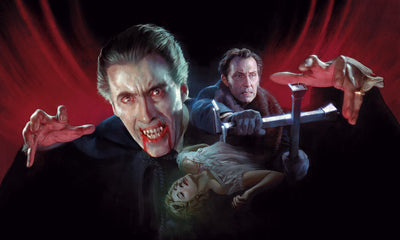
Yes, we’re delighted to confirm that the Limited Collector’s Edition of Hammer’s iconic masterpiece, Dracula (1958), is available to pre-order now. And for connoisseurs of the Count, we’d recommend taking a look at the Limited Collector’s Blood Edition. Restricted to a mere 1,000 individually numbered sets, it’s a rare, collector-only variant exclusive to Hammer Films.
Whether you’ve watched the movie a million times or you’re looking forward to enjoying this classic for the very first time, there’s never been a better way to experience Dracula. Simply visit Hammer’s online shop to pre-order your copy of… Well, your copy of one of the most thrilling and influential films of all time.
It comes with an extraordinary array of new material including specially produced features, treasures from the archive and a 200-page book, all exclusive to this release.
There’s a lot to unpack with this one, so we turned to Hammer’s Steve Rogers to get the full story, starting with his definitive description and account of Terence Fisher’s director’s cut of Dracula, plus inside scoop on how the film was so beautifully restored.
Not wanting to skimp on the facts, we’re delivering a multi-part Q&A that gives you everything you need to know about this landmark edition of Dracula and the material accompanying it…

He’s back…
Hammer News: Thanks for meeting up, Steve. Since the big Dracula announcement I’ve chatted to plenty of friends who are horror fans - all looking forward to this release, of course, although some have bickered about the exact version of the film we’ll be getting. I know you’ve discussed it before and pointed out this is the work as director Terence Fisher intended… But could you reiterate what that means, and for anyone who’s missed previous announcements, restate how and why this version of Dracula represents the definitive cut?
Steve Rogers: There was only ever one version of Dracula filmed – the one that Terence Fisher made for Hammer. It was then subsequently censored by the BBFC in the UK – and slightly less censored in America. In Japan – and apparently some parts of Europe – it was shown uncensored (I'll come back to that point in a little while), which is why it's sort of become known to posterity as ‘The Japanese Version’ even though it's not – a situation which was muddied when producer Tony Hinds told a film magazine in 1958 that they were creating an extended version with more blood in it just for Japan. They weren't – it's just that the Japanese weren't expected to censor the original film.
HN: Sounds messy…
SR: It is, but that's the way it was back then – and still is to a certain degree now. Different countries censored films in different ways but, seemingly, Japan had a higher tolerance for such things. This is why, when fan Simon Rowson doggedly tracked down a copy of an incomplete, water-and fire-damaged copy of ‘The Japanese Version’ in 2011, great rejoicing was witnessed worldwide and elements of that damaged print were edited into the then-current Dracula restoration and released on Blu-ray. Everyone believed that was as good as it would ever get.
HN: Well, we now know that wasn’t to be the case (cue more great rejoicing), but take us through what happened next…
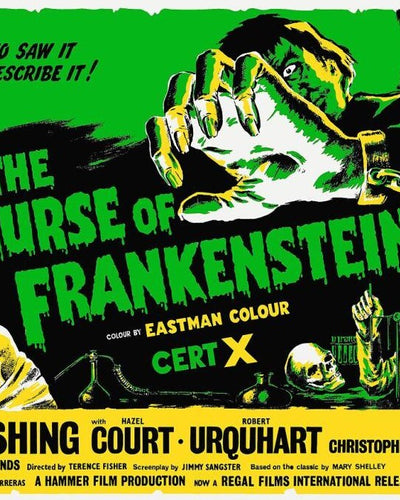
SR: When Hammer and The Warner Archive Collection partnered up to restore The Curse of Frankenstein in 2025, it was such a great experience for everyone involved that it was obvious that Dracula would be next. It was already known that Warners held the best materials for restoration (in this case, the negatives) but they had also recently discovered a can marked up as containing ‘Japanese inserts’. On examination it was discovered that not only did this can include pristine versions of the censored shots that had previously been recovered in poor condition, but there was also an additional shot seemingly not in the Japanese print (so maybe Dracula was actually censored in Japan after all?).

A moment between Jonathan Harker (John Van Eyssen) and Vampire Woman (Valerie Gaunt) would prove problematic…
HN: Okay, so what was actually censored in the UK?
SR: The original 1958 censorship discussion between Hammer and the BBFC identifies various sections of the film with which the BBFC had big problems, which include; Lucy being staked, Mina being seduced by Dracula and the final disintegration. All of these feature fully and uncut in the new restoration, for the first time ever. We can also see that these sections are marked up in a very specific way on the editor’s cutting copy (which is also included in the collector’s edition, and is the only Hammer cutting copy known to exist). This gives great insight to the back and forth process with the censors.

Carol Marsh (born Norma Lilian Simpson) portrayed Lucy. The character’s ‘final death’ scene was another which became a pain in the neck for the BBFC…
HN: Fantastic. Could you talk us through the actual restoration process?
SR: The restoration, like The Curse of Frankenstein, was a collaboration between The Warner Archive Collection, Hammer and Hammer’s restoration partner, Silver Salt. Warners assessed their inventory of Dracula material and digitally scanned the best film materials for restoration. These 4K scans were then sent to Silver Salt, who carried out extensive restoration over a 6 month period. Do you mind if I quote a couple of sections from my colleague restoration notes?

Valerie Gaunt’s character prepares to feast on Jonathan Harker…
HN: Please do…
SR: “Digital Vision Phoenix, HS ART Diamant and MTI software were used for the dirt removal. HS ART Diamant was also used to stabilise any weaving or movement whilst preserving original facets such as camera moves and also to de-flicker the image (there was density fluctuation throughout with the colour completely changing throughout some scenes).”
“The sequences from the Japanese insert reel – being a generation away from the original negative – meant much additional work: carefully re-aligning colour channels (so no edge fringing is seen), intensive restoration to remove dirt and blemishes and processing for flicker/colour breathing. The shots were carefully graded to seamlessly flow visually with the original material.”
HN: Hey, you had me at ‘Digital Vision Phoenix’.
SR: The film has been graded to a colour palette similar to The Curse of Frankenstein, accurately matching the original colour and tone of Jack Asher's cinematography. It was a considerable amount of work by all three companies, but the results speak for themselves and this restoration looks astonishing – it's undoubtedly the best this landmark film has ever looked, and Dracula can now be seen as Fisher and Hammer originally intended.

The first film to feature Peter Cushing as Van Helsing (above) now looks better than ever.
Big thanks to Hammer’s Steve Rogers for providing this comprehensive outline of Dracula and more specifically, Terence Fisher’s director’s cut of the film. Our Q&A then turned to the enduring importance of the movie, and we discussed the bonanza of new and archive features produced specially for this release. You’ll be able to read all about it soon!
In the meantime, you can visit Hammer’s online shop now to secure your copy of the Limited Collector’s Blood Edition. Daring. Definitive. Dracula as it was meant to be experienced.